


The first time I ever heard a Tom Zé record was a couple years back. I was sitting in my living room while a coworker put a selection of Brazilian tropicalia records from the early ’70s on my turntable—Caetano Veloso’s sensual croon-rocking, the frenetic, almost looped repetition of Gal Costa’s India. But none of them were as surprising as Zé. As soon as the needle dropped on his 1973 album Todos Os Olhos, I was blindsided by what I heard—and what I saw. The cover of the album is a close-up photograph of a marble clinched in an anus; the picture has been rotated 90 degrees so that together, anus plus marble equals eye: All The Eyes.
The music was grounded in a heavy-hitting samba rhythm, with bright but jarring acoustic guitar, choruses singing ecstatically in mush-mouthed Brazilian Portuguese, and what sounded like vacuums shrieking hysterically, terrorizing the percussion with an electro-future industrial glee. The music sounded experimental as all hell—it always playfully operated at two opposite sonic poles simultaneously—but wild experimentation doesn’t make you recklessly, happily confused. Pop music does.
If there is any one defining feature of Tom Zé, it is his ability to create contradictions and delight in them so completely that, ultimately, he’s able to have it both ways. The music sounds as though it’s built with blocks made from a mixture of elements that are, elsewhere, simultaneous impossibilities: the country and the city; the living room and the street; the third world and the first; the organic and the industrial; pure sound and pure emotion; pure intimacy and pure collectivity; the familiarity of tradition and the surprise of the avant-garde. The result is music that is only elementally—not holistically—weird. Zé is distinct from almost everyone else who has been called avant-garde because the “difficulty” for the listener that the tag implies doesn’t really apply to him. He has taken brilliantly bizarre, creative and intellectual routes to making music that is utterly joyous, listenable and often danceable—if not always hummable.

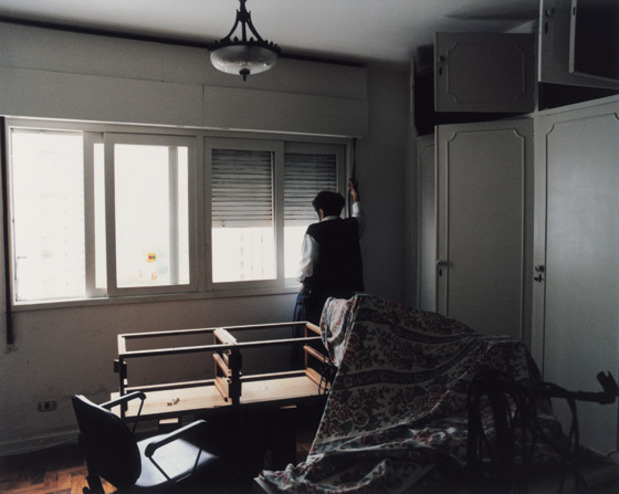
Born in the state of Bahia in Northeastern Brazil in 1936, Tom Zé now lives in São Paulo, where he runs his production office out of his apartment with his wife Neusa. He wakes up at six in the morning to practice Tai-Chi, and when the in-house office closes at six in the evening, Neusa reads to him; on one recent evening they read Harold Bloom’s Where Shall Wisdom Be Found? In talking me through his daily routine, Zé (through his friend and translator Chris Dunn) refers un-specifically to his “work.” I ask him what “work” means, and he says, “I’m doing something very important: I’m becoming literate.” It turns out that by “literate,” he means learning how to use a Mac for email and the basics of a sound editing program. The playful manner of speaking—and the investment in computer literacy—is classic Zé, whose long musical history is inextricably intertwined with literature, Dadaist turns of phrase and technology.
In the late 1960s, bossa nova had firmly taken hold of Brazil, until a loose collective of young intellectual musicians stripped it away from all of its factions—those who were making hits with it and those who were making protest music with it and those who were doing both. They opened it up by incorporating rock & roll from outside of Brazil as well as rural music like forró and contemporary classical or “serious” music from within, re-imagining bossa nova as a broad, miscegenated, playful, postmodern version of itself. They used commercial jingles to out-pop pop and the Dada-like lyrical circularity to out-subvert the protestors. The manifesto of Veloso, Gilberto Gil, Zé and others was a compilation album called Tropicalia Ou Panis Et Circensis and it forcefully announced their arrival. The individual careers of Veloso and Gil would explode after their introduction; Zé, however, stuck closely to his own unique version of tropicalia’s mold and experimented within that framework. He built a homemade instrument that was more like a madcap inventor’s contraption: a series of doorbells on a keyboard that triggered blenders, vacuums, floor polishers and more. Despite his initial association with Veloso and Gil, however, he faded into obscurity over the course of the ’70s. Years after Zé had disappeared from the public consciousness of both Brazil and America, in 1989, David Byrne was digging for records in Rio when he he blindly picked up an album called Estudando O Samba. Stunned by what he heard when he got back to his turntable in New York, he enlisted the help of Arto Lindsay and tracked down the man responsible for the 1976 album, who, at the time, was apparently without a record deal and on the verge of leaving São Paulo to pump gas at his cousin’s fuel station. But in 1990, Byrne’s label Luaka Bop released Brazil Classics 4: The Best Of Tom Zé. The critics, Brazil-obsessives and general music lovers everywhere were thrilled with what has been largely (if grotesquely) called Byrne’s “discovery.” Since then, Luaka Bop has also released The Hips Of Tradition: The Return Of Tom Zé (1992) and Fabrication Defect (1998), and in 1998 Zé toured America with his frequent collaborator Jarbas Mariz and Chicago indie-experimentalists Tortoise as his backing band. Onstage, he and Mariz donned helmets and knocked out sambas on each other’s heads; he led audience sing-alongs of “Hey Jude”’s “na-na-na-na” chorus; in hesitant English, he invited everyone to plagiarize anything from everyone freely.
America’s obsession with music from the rest of the world generally works in waves, but the fascination with Brazil is now well entrenched. Byrne founded Luaka Bop in 1989. Beck recorded his song “Tropicalia” for Mutations in 1998 and a similar Brazilian influence is all over 2005’s Guero. Samba and bossa influences have peppered the releases of Chicago indie and indie-jazz bands like Tortoise, the Sea And Cake and the Chicago Underground collective throughout the ’90s and ’00s. In 2005, Diplo and MIA helped spark dance parties based around the lo-fi “funk” coming out of Brazil’s favelas. Caetano Veloso was photographed backstage at Carnegie Hall for this magazine. Perhaps, then, it should just be annoying, not surprising, that the reviewers of Zé’s short 1998 tour were already falling into the initial stages of snark: it was as though the more defensively elitist critics were already saying, “He’s got that exotic Brazilian thing that you assholes can’t resist.”
“What they are suggesting doesn’t matter to me one way or another. I am someone who does a different kind of cultural work. I can’t get lost, because I myself am lost myself. I embody lost. I can’t get lost, because I am lost itself.”
Although Tom Zé lives and works largely outside of the specifics of that conversation, the spaces it creates are nevertheless his playground. Zé tells me that there’s an ongoing conversation in Brazil regarding the state of “the song,” the song being something of a national treasure there. Apparently, research conducted in São Paulo shows that the young generations aren’t engaging in any sort of collective exchange of ideas, and they have painfully short attention spans. Some are saying that the great era of Brazilian songwriting is over. Zé responds to this public conversation saying, “I don’t have this romantic myth that I’m an inspired genius or a great tunesmith—the sirens don’t sing for me. So what they are suggesting doesn’t matter to me one way or another. I am someone who does a different kind of cultural work. I can’t get lost, because I myself am lost myself. I embody lost. I can’t get lost, because I am lost itself.” In removing himself from the conversation about song in Brazil, Zé also sidesteps those fans in America who fetishize his zaniness, his funkiness, his Brazilian-ness, and those critics who are snarky about it. Part of the fun of listening to his records is the joy of channeling Zé’s postmodern sense of himself as an outsider—lost!
In March, Tom Zé’s newest album, an “operetta” (of sorts) called Estudando O Pagode, comes out in the States. The first song, “Ave Dor Maria” is an almost club-ready rocker. The verses and choruses are built from a dirty, chunky guitar line, straight-ahead rock drumming, an almost spitting vocal about the evil of women and a brash call-and-response between a menacing saw and the wimpy squeaks of a toddler’s toy. It breaks, however, for a surprising bridge, in which the band finds a deeply funky groove while a woman sings a spiritualized call to the Virgin Mother, asking her to protect women from “the afflictions visited upon us by men.” Over the next 15 tracks, Zé leads the band and various choruses through an elaborate mess of songs that alternately scream and whisper, dance and cry, hold tight in the pocket and spazz out completely. Almost all of the songs are busy, but Zé and his young producer Jair Oliveira use space to open the songs up and create a diversity of feeling. Sometimes the sounds are tight, claustrophobic and in-your-face, as though the band is in your living room; other times the songs are open, airy and distant, as though the music is seeping through the windows from blocks away.
Pagode is essentially a concept album about pain and sexuality—it understands the world as a matrix of male domination. The characters include a jury, a chorus of accusers, a donkey, a “feminine orgasm,” a professor, Don Quixote, a homosexual group parading at the Vatican, and so on, and the story is framed as a brutally lopsided battle of the sexes. Zé conceived of the record in 2000, while reading about the history of women in labor on a flight from Portugal to Brazil. Then, when back in São Paulo, he read a report that 70% of Brazilian university women don’t enjoy sex and don’t feel comfortable talking about it. “At first, I thought of it not from this broader cultural perspective, but in terms of my own personal experience as a man and my relationships with women,” Zé remembers. “I was noticing how I had an early girlfriend where it seemed like she enjoyed having sex, and then I had many girlfriends after where there was a sense of reticence or repression—that they weren’t enjoying it. For many women, whether it’s conscious or not, men can potentially be an enemy, and that would explain why, in moments of intimacy, it would be very difficult for women to participate.”

The word “pagode” (pronounced, approximately, pa-go-jee) in the title Estudando O Pagode, is the name for a style of party music that’s a stripped-down sub-genre of samba, born in Brazil in the late ’70s and early ’80s. Zé reminds me, however, that before the term referred to a kind of music, it was a disparaging name for someone who is unreliable, dishonest, a sort of sly hustler. Pagode also carries class implications. Zé lives on a street of high rise apartments in São Paulo and his building is flanked by buildings that house working class residents on one side and elite residents on the other. Pagode is extremely popular among Brazil’s working class (some albums sell in the millions), and Zé hears the music coming from the more modest apartments every weekend. Yet the music is disparaged by the elites who live on the same block.
Zé also notes, however, that pagode itself is a very masculine form, full of sexually derogatory language; there is a bottle dance performed to the music in which a woman grinds suggestively over a bottle that stands on the floor between her legs. Pagode, then, is a fitting touchstone for Zé’s album: the record is based on a music that has been excluded and marginalized, but also itself excludes and marginalizes. On new song “O Amor É Um Rock”, a series of choruses curse love over a blunt, wah-wah-heavy guitar riff, saying, “Love is egotistical,” “Love cares only for itself,” and “Love is a rock song/ And it’s personality is pagode.”
At their most immediate, Tom Zé’s songs sound like the inspired machinations of a genius who’s just a little bit mad—a little bit crazy. Yet as I spoke with him and listened to him chatter in Portuguese, it seemed like the craziness—the circularity, the intentional obfuscations, the contradictions—somehow came closer than anything straightforward to touching the elusive capital-t Truths that music strives for, almost like those half-life fractions from ninth grade biology that keep approaching zero even though they can never quite get there.
While working on the transcription soon after our interview, I noticed something that I hadn’t noticed during the actual conversation. When Zé said that he’s not a part of the great line of Brazilian tunesmiths, he added, “the sirens don’t sing to me” rather than “the muses don’t speak to me.” It could have just been a matter of translation, but still, the distinction between the two seems important: the muses inspire the poet, while the sirens drive their listeners insane. Before talking to him, I would’ve imagined Zé as an Odysseus-like character, a proud and brave eccentric who would stuff wax in the ears of his crew but lash himself to the mast of the ship so he could listen to the sirens without wrecking the boat on the rocks—someone who would have it both ways. But perhaps the rest of us are the ones trying to be the brave warrior-hero Odysseus, going mad as the sirens sing for us, and Zé’s got the wax in his ears. He’s aware of what’s going on around him, but is ultimately willfully lost—maybe working on some new lyrics, figuring out how to make music on his new computer and, after six o’clock, listening thoughtfully as his wife reads aloud to him.
