 Photo by Krista Garza
The hallowed Palacio de Los Deportes of Mexico City has been transformed into heaven on Earth. Mexican youth in sky-blue jerseys, crop tops, and light-up halos swarm the grounds to witness the second coming of the Mexican pop idol Humbe. Inside the arena, big fluffy clouds float above while a singular, pearly white staircase sits on stage illuminated by a spotlight, the place where the 25-year-old singer will suddenly appear not long from now to deafening screams. His fans are hungry; After a yearlong hiatus from the stage and without releasing any new music, Humbe sold out this concert in just a few days.
A day before the November 30 show, Humble sits in a hotel conference room dressed just like his fans: a blue Dueño del Cielo trucker hat, crop top, and boots with white fur. “This concert means the world to me,” he says, emanating zen as he meditates on his answers. He had announced the show without much notice or details of what to expect. “I feel very honored to do a concert without people even knowing what the fuck it's about. I could just come out and say hi and leave, but I love that my fans are really there for the music.”
 Humbe performing at Palacio de Los Deportes in Mexico City on November 30.
Photo by Krista Garza
Humbe performing at Palacio de Los Deportes in Mexico City on November 30.
Photo by Krista Garza
 Humbe performing at Palacio de Los Deportes in Mexico City on November 30.
Photo by Krista Garza
Humbe performing at Palacio de Los Deportes in Mexico City on November 30.
Photo by Krista Garza
For the last five years, Humbe has dominated the Latin pop scene with his soulful and sentimental hits, breaking out with 2020 song “Confieso.” As música Mexicana, specifically corridos, has put Mexico on the global stage with songs primarily by men that glorify drugs, partying, and living large, Humbe and his vulnerable, R&B-infused pop sit in a separate lane. Pop music in Mexico is a genre largely run by women but Humbe has held it down for the pop boys, selling out tours across Latin America.
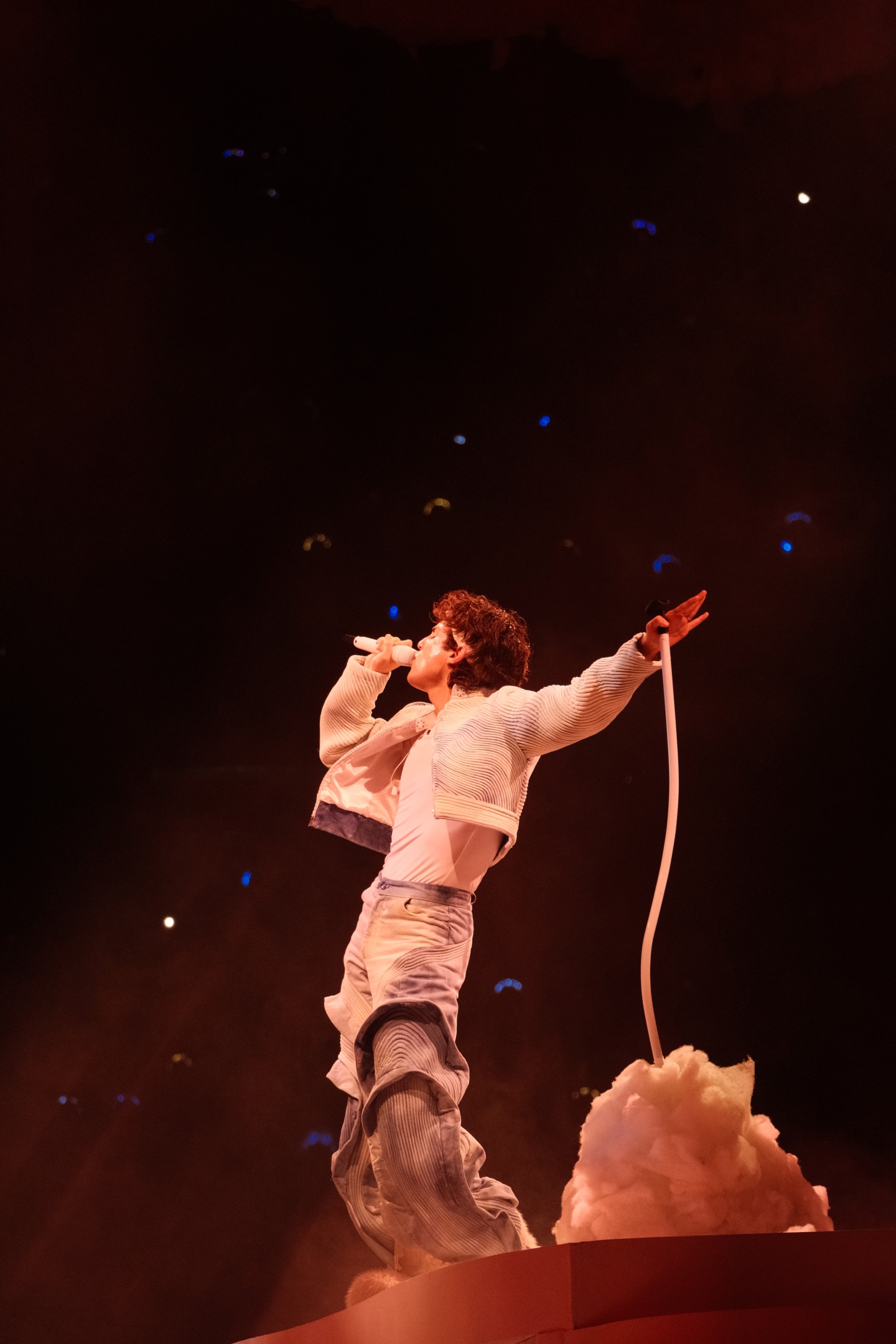 Humbe performing at Palacio de Los Deportes in Mexico City on November 30.
Photo by Krista Garza
Humbe performing at Palacio de Los Deportes in Mexico City on November 30.
Photo by Krista Garza
Humbe was born Humberto Rodríguez Terrazas in Monterrey, Nuevo León. Growing up in a family of singers and musicians, he began playing the piano at age 9 after his father grounded him and made learning the instrument his punishment. He cites Beyoncé as his biggest musical inspiration, as well as Daniel Caesar, Frank Ocean, and Sampha, influences that have filtered into his music. “R&B is a genre that I've fallen in love with throughout the years,” he says. “I don't abstain from exploring every other genre. I love going to the studio without having anything in mind. I love doing whatever feels right or natural at that moment.”
I love that my fans are really there for the music.
As a teen in high school, Humbe used YouTube to teach himself how to produce music, and in 2021, wrote, recorded, and produced his debut album, 2021's Entropía solo in his bedroom. All except for the electrifying “Kryptonita,” which he worked on with his brother Emiliano Rodriguez. In the deep cut, Humbe likens a debilitating breakup to Superman in the presence of his weakness, Kryptonite. “When I showed [‘Kryptonita’] to him, it was the first time that we clicked because he started giving me ideas to change some things to make that song flourish," Humbe says. “Working with him ever since keeps me grounded.” Emiliano remains his longest-standing collaborator.
Following the release of Entropía, Humbe signed to Sony Music Latin and released a string of hit singles, the soaring “El Poeta” and the dreamy “Dieznoches.” Around that time, his TikTok account, where he would upload videos sharing his song-making process, also significantly boosted his following. In 2021, he was nominated for Best New Artist at the Latin Grammys, a recognition that he says he “still can’t believe” happened.
“I don't know if I consider it an achievement because I've never done anything with my music with the intention of getting an award, but it does feel very special to get recognized in that way,” he says.
 Humbe performing at Palacio de Los Deportes in Mexico City on November 30.
Photo by Krista Garza
Humbe performing at Palacio de Los Deportes in Mexico City on November 30.
Photo by Krista Garza
By the time he released 2021’s astral Aurora and 2023’s ethereal Esencia, Humbe had become a major force in Mexico’s pop genre — an achievement for a male singer in the country. The last major male pop star from Mexico was Luis Miguel, affectionately known as “El Sol de Mexico,” or the “Sun of Mexico.” After his dominance in the ‘80s, ‘90s, and 2000s, the heartthrob archetype soon gave way to cowboy-style corrido singers. Since then, the corridos stars have infused their music with elements of trap and embraced American hip-hop aesthetics. Their songs speak about numbing heartbreak with drugs, violence, and riches, feeding into machismo ideas that Humbe says he’s never subscribed to. On the contrary, his feelings are his greatest strength on his romantic and emotional songs like “Amor de Cine” and “Te Prometo.”
“I feel it's kind of stupid it’s even a thing that men can’t cry,” Humbe says. “It’s literally the body’s way of releasing emotion through literal tears. One of my best hobbies is crying. When they see you can be happy, that machismo and that shit just goes away. It’s systematic. It’s programmed into people, but it’s a stupid mindset that I never believed in.”
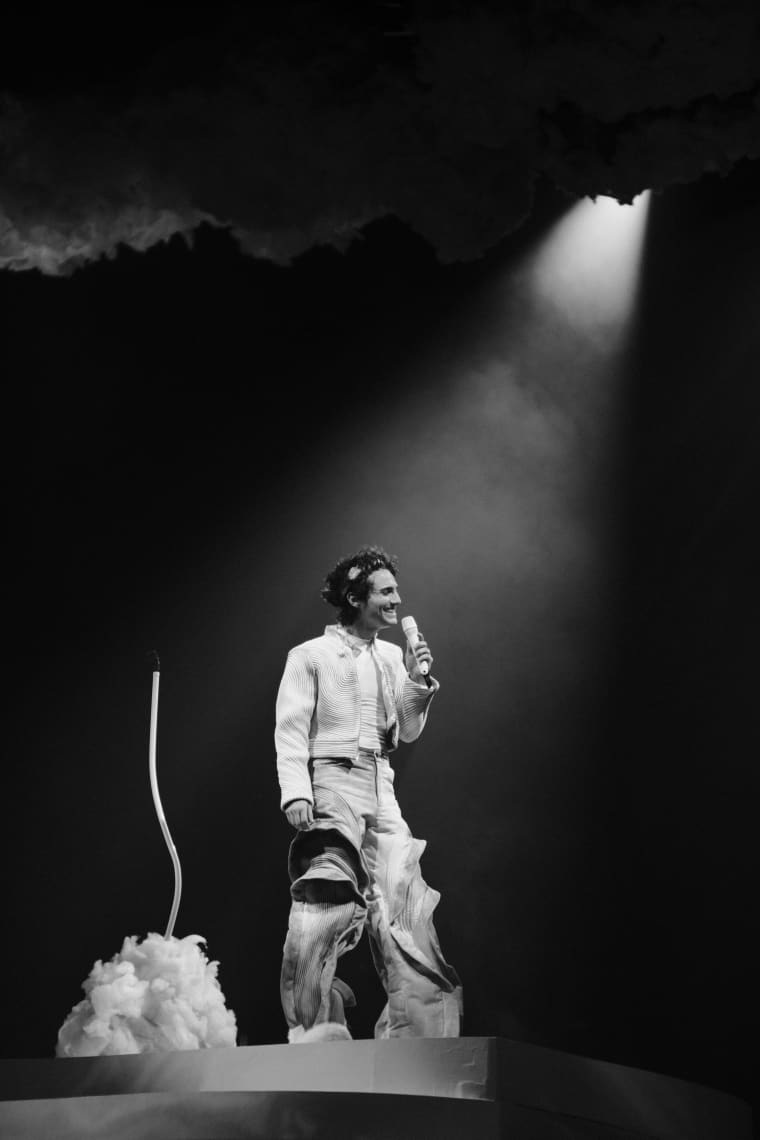 Humbe performing at Palacio de Los Deportes in Mexico City on November 30.
Photo by Krista Garza
Humbe performing at Palacio de Los Deportes in Mexico City on November 30.
Photo by Krista Garza
 Humbe performing at Palacio de Los Deportes in Mexico City on November 30.
Photo by Krista Garza
Humbe performing at Palacio de Los Deportes in Mexico City on November 30.
Photo by Krista Garza
When they see you can be happy, that machismo and that shit just goes away. It’s systematic. It’s programmed into people, but it’s a stupid mindset that I never believed in.
At his concert, Humbe freely bumps and grinds to his sexier offerings like “50mm.” When I ask if the repeated “enfócame bien” lyric (which, when sung, sounds like an inviting “fuck me” in Spanglish) from that song has a double entendre like Britney Spears’s “If U Seek Amy,” a grin appears on his face. “It can mean what you want it to mean,” he says.
In November 2024, Humbe revealed that he parted ways with Sony, and in a very rock star move, christened his new era independence with a dark-pop album, Armagedón. Leaning more into his sensuality with songs like the sultry “Kintsugi,” it showed his growth not only as an artist, but on a personal level as well: the pristine pop star letting his wavy locks down and embracing artistic liberation. Since going indie and jumping off the major label hamster wheel, Humbe says he has found a “sense of peace” while making music. It is, he adds, the “most powerful and valuable thing an artist can have.”
His latest moves continue to build that path. On December 6, he released Dueño del Cielo, the “resurrection” after Armagedón, he says. In English, the title translates to “Master of the Sky;” it was recorded this past year in Iceland with his brother, sister-in-law, and producer Navi to close out the trilogy of albums that started with Esencia. Inspired by Bon Iver, Dueño del Cielo is loaded with imaginative songs like the aforementioned “50mm” and the haunting mariachi ballad “Fantasmas,” which goes viral online every Día de Muertos (Day of the Dead).
On stage at his November 30 concert, while performing the tender love song “Morfina”, Humbe floats toward the clouds that fill the arena while strapped in a harness supported by a single chain. The ambitious show included a full orchestra, a mariachi band, and Humbe flying over his fans performing P!nk-like aerial tricks. A thrilling preview of what’s in store for 2026, when he embarks on his first extensive tour of the U.S. in 2026.
“I want to have fun with it in every sense of the word,” he says of the upcoming shows. “With my last tour, I was really pressured to start dancing. Now I've had time to prepare even better, more beautiful, and more me choreography. It’s time for me to enjoy it.”