
 Photo credit: Lexie Alley
Over the last decade, Mitski has consistently disproved the longest held music biz adage: that you have to conform to trends to reach mass appeal.
The Japan-born, world-raised artist has been a massive musical force for over a decade, but she reached new TikTok-powered heights in 2023 when her song “My Love Mine All Mine,” from The Land Is Inhospitable and So Are we, smashed through the ceiling to 1.8 billion streams on Spotify. Crucially, the song does not sound like your typical TikTok-optimized hit. It’s a good old fashioned Mitski strange: melodically liquid, instrumentally grand, lyrically piercing, a pulsing vein of feeling.

When she announced her new album, Nothing’s About To Happen To Me, in January, the question on my mind became: what happens next after you’ve bared yourself for the world to see and become impossibly, maybe even nightmarishly, famous? For Mitski, the answer appears to be a record that shuts us inside a private abode and invites us to pace the halls, and peer out the foreboding windows, beside her.
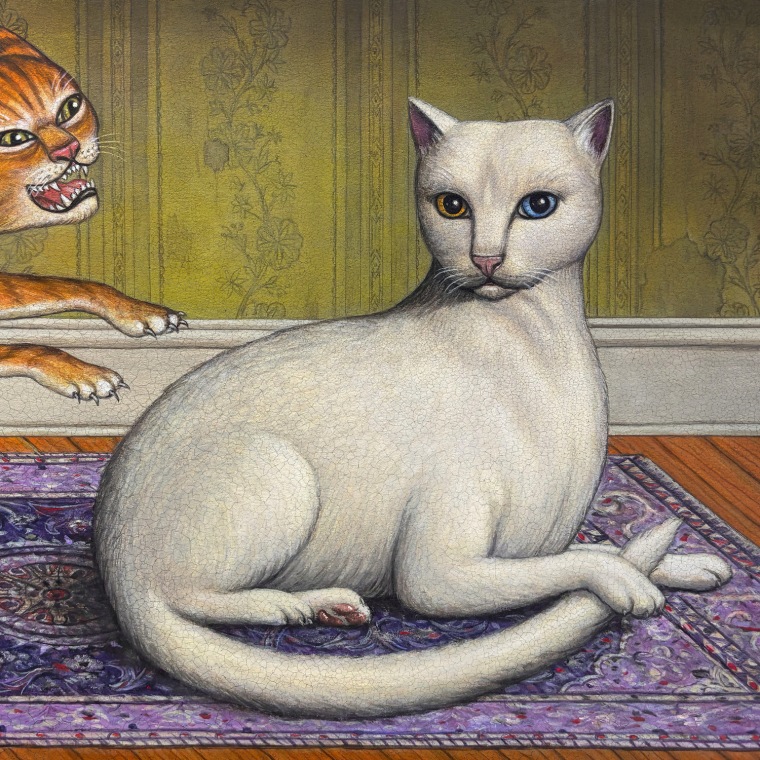 Album art: courtesy of Mitski
The conceit of NATHTM is about the thin line between liberation and lunacy that can emerge while trapped inside your own domestic safe harbor. It’s her rockiest album since Puberty 2, meaning it bristles with a directness that is often confrontational and immediate.
There’s a line in the album’s sea shanty-sounding opener, “In a Lake,” that is one of the more succinct descriptors of what fame must feel like for the nitpicked upon and parasocially attached: “I’ve tried very hard to be good / But when they think you’re bad, people act worse.” When she was still semi-online, overly-invested fans and haters alike mined her father’s career with the U.S. State Department and dogpiled her after she complained about her concerts morphing into a sea of phones; she’s spoken openly about the trauma of being written about. No one would know better about the pains of perception than Mitski.
Alienation and isolation have always been prevailing themes in Mitski’s work (see the 2018 existential banger “Nobody” or 2015 mirror-smash, “Happy”), but the panopticon terror of Mitski’s global notoriety has made her writing on the subject even more visceral and bloodied. In 2024, Rolling Stone reported that Mitski had welcomed Chappell Roan into pop’s upper echelon with a note that read: “I just wanted to humbly welcome you to the shittiest exclusive club in the world, the club where strangers think you belong to them and they find and harass your family members.”
It makes sense then that NATHTM was announced with a Grey Gardens-esque horror flick as the music video for the guitar-driven delirium of “Where’s My Phone?” In it, the singer and her family are being visited, or attacked, by a hoard of nosy neighbors. Whether they’re coming with sugar or with murderous intentions is besides the point. “Stay away from me, all of you,” Mitski seems to be saying.
The rest of the album hopscotches through the things she holds on to for comfort amidst the eyeballs and social media fodder. She honors her domestic feline friends on “Cats” and a loyal and forgiving lover on “If I Leave;” and sometimes she finds solace through a direct conversation with death (or dissolution), like on “Instead of Here” — a continuation of a longstanding focus on the eternal in her music.
The album can feel at times stuck in its own abyss: a private, protective sphere that is depicted as a horror movie with a twee Wes Anderson bend to it. If not for its closer, the album would end with two back-to-back songs about animals visitors — cats on “The White Cat” and hounds on “Cahron’s Obol” — who at times seem as if they’re friends and spiritual foes. In the rare moments Mitski’s narrator ventures into the chaotic and dangerous outside world, the album and the listener can breathe a little. On the oh so romantic “I’ll Change For You,” she invokes the strange joy of a night at the bar, singing, “You can be with other people / Without having anyone at all.”
The album ends on the cosmic “Lightning,” on which she wonders, “When I die / Could I come back as rain?” The line is sung in her grim affect, but it points to wider spiritual transcendence beyond the smallness of the locked up home. I can’t tell if that transcendence feels like freedom or tragedy for Mitski’s narrator — or Mitski. Maybe it’s both.