

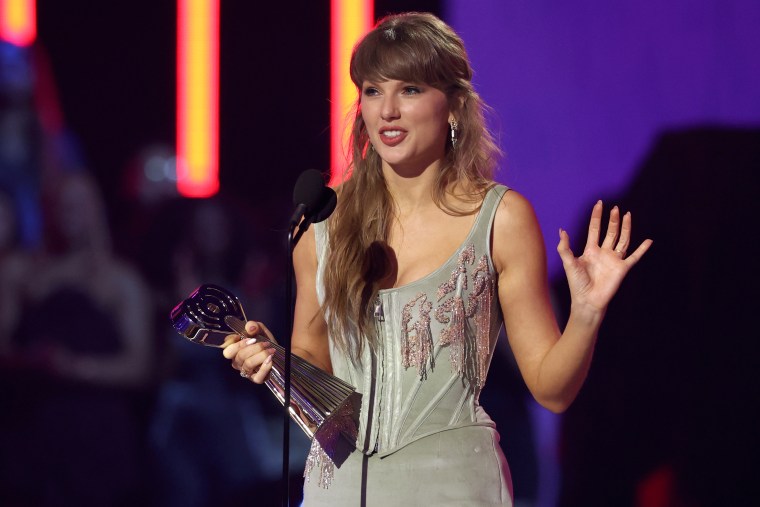
 Photo by Monica Schipper/Getty Images
Taylor Swift is making moves to protect her likeness from the threat of AI.
On April 24, the Life of a Showgirl singer filed trademarks pertaining to the use of her voice saying "Hey, it's Taylor" and "Hey, it's Taylor Swift." Swift's team also filed a visual trademark of a recent photo from her Eras Tour of her wearing a bejeweled outfit and holding a pink guitar.

"Attempting to register a celebrity’s spoken voice is a new use of trademark registration that has not been tested in court before," writes trademark attorney Josh Gerben.
While Taylor's voice saying the aforementioned phrases is noted as a specific sound mark (famous examples of trademarked sound marks include NBC's chimes), Gerben notes that those trademarks could allow her to also "claim that any use of her voice that sounds like the registered trademark violates her trademark rights."
"If anyone creates anything using that voice with AI, Taylor and her legal team could argue it violates her trademark rights," adds Gerben.
That's a crucial point, given that AI models use existing material to produce new content — a key issue for intellectual property (I.P.) rights holders. For example, Disney sent a cease-and-desist letter to Google in 2025 after noting that. their Gemini AI platform was being used to generate copies of its trademarked characters.
Similar issues have arisen in music. In December 2025, controversy arose after Jorja Smith alleged that an electronic artist HAVEN was using her voice to train AI vocals on the breakout hit song, "I Run."
"The usage of efficacy of AI is growing at an alarming rate and substantially outpacing regulation," Smith's label FAMM wrote in December. "AI material should be clearly labelled as such so that the public can choose whether they consume AI material or not. And creators who are happy for their protected works to be used to train AI should be credited and compensated accordingly."
"Trademark law doesn’t just stop identical uses (like copyright law): it stops anything that is confusingly similar to the registered trademark," adds Gerben. "That’s a much broader right and more powerful tool in an AI world."
The legal terrain is still murky, but these broader trademark protections are looking like a powerful way for public figures and artists to protect their likeness. For example, Matthew McConaughey filed similar protections over the use of his signature phrase, "Alright, alright, alright," among other sound marks.
Only time will tell if Swift is out of the woods on her AI fight, but, regardless, the world's biggest pop star making these legal maneuvers is a telling sign for the future of this persistent issue.

