Nia Archives goes alternative
After hitting a peak in her career, the acclaimed London junglist returns with a record that rewires her high-BPM sound with a full band.


 Stuart Nimmo
Nia Archives was ordering a Diet Coke when she was recognized at the bar.
The 26-year-old is nestling into the corner booth of a north London pub and telling me what just happened. Dressed in a leather bomber jacket and jeans, her blunt bangs framing a playful grin, she smiles as she recounts how she told the server yes, she is the artist whose heartfelt take on jungle has taken her from the tiniest clubs in London to opening for Beyoncé and remixing for PinkPantheress and Fred Again. Seconds before I press record and we begin speaking on the record, the spiky riff of her latest single “Boys In Blue” filters through a nearby speaker. The bartender has put it on the stereo to show her affection. Nia laughs, her green tooth gems sparkling, and swears she’s hardly ever noticed in public.

Nia prefers to stay under the radar after her life changed in 2021, when her song “Forbidden Feelingz” blew up while she was attending University of Westminster. “I didn’t like being the centre of attention,” she says of the shift. “All of a sudden I had people perceiving me. I hated it.” Career landmarks — headline tours and packed out festival tents — became a challenge to an emerging artist who went from making music in her dorm room to seeing herself on billboards at breakneck speed. She considers it an achievement now, but the whole time she was doing it she only remembers feeling “so uncomfortable.”
It is the symbiosis between good times and the awkward that makes Nia Archives music so rich. Her 2024 debut, Silence Is Loud, was a blast of ‘90s U.K. rave production and Jamaican sound system culture cut with unexpected samples of Brazilian choirs and old episodes of Columbo. Songs like “Forbidden Feelingz” and “So Tell Me…” didn’t use jungle’s syncopated percussion loops and rumbling bass lines as a purely nostalgic exercise. They were a vessel for songwriting that revealed an inner torment at odds with the party vibes and frantic BPM count. “Misunderstood by everybody / The party girl who's all alone,” goes a line on “Crowded Roomz.” “I should go home, but something just stops me.”
That same sensitivity can be felt on her forthcoming sophomore album Emotional Junglist, dropping July 17. It’s split in two like a broken heart. The first part is filled with love and the crackle of a new relationship while the second deals with the fallout from an abrupt break-up. Lead single “Boys In Blue” represents a defiant ending as well as the darkest time in the relationship when her ex called the police on her.
Speaking of the song and the experience that inspired it in person, Nia says she was “blindsided” when her ex suddenly broke up with her hours before she was due to play a London festival last summer. Understandably emotional, she says she demanded he explain his decision.
“He tried to run out the door and I was like, no, you need to explain to me why you're breaking up with me.” As she explains it, he then called the police when she urged him to stay and talk. “I've never really had that kind of drama and I felt so fucked from it,” she says today. The experience was all the more dangerous for Nia, a Black woman at higher risk of mistreatment by police in the city. “When the police came they didn't even speak to me,” she says with disbelief. Instead, they addressed her white male friend. “They just told me to stop crying.”
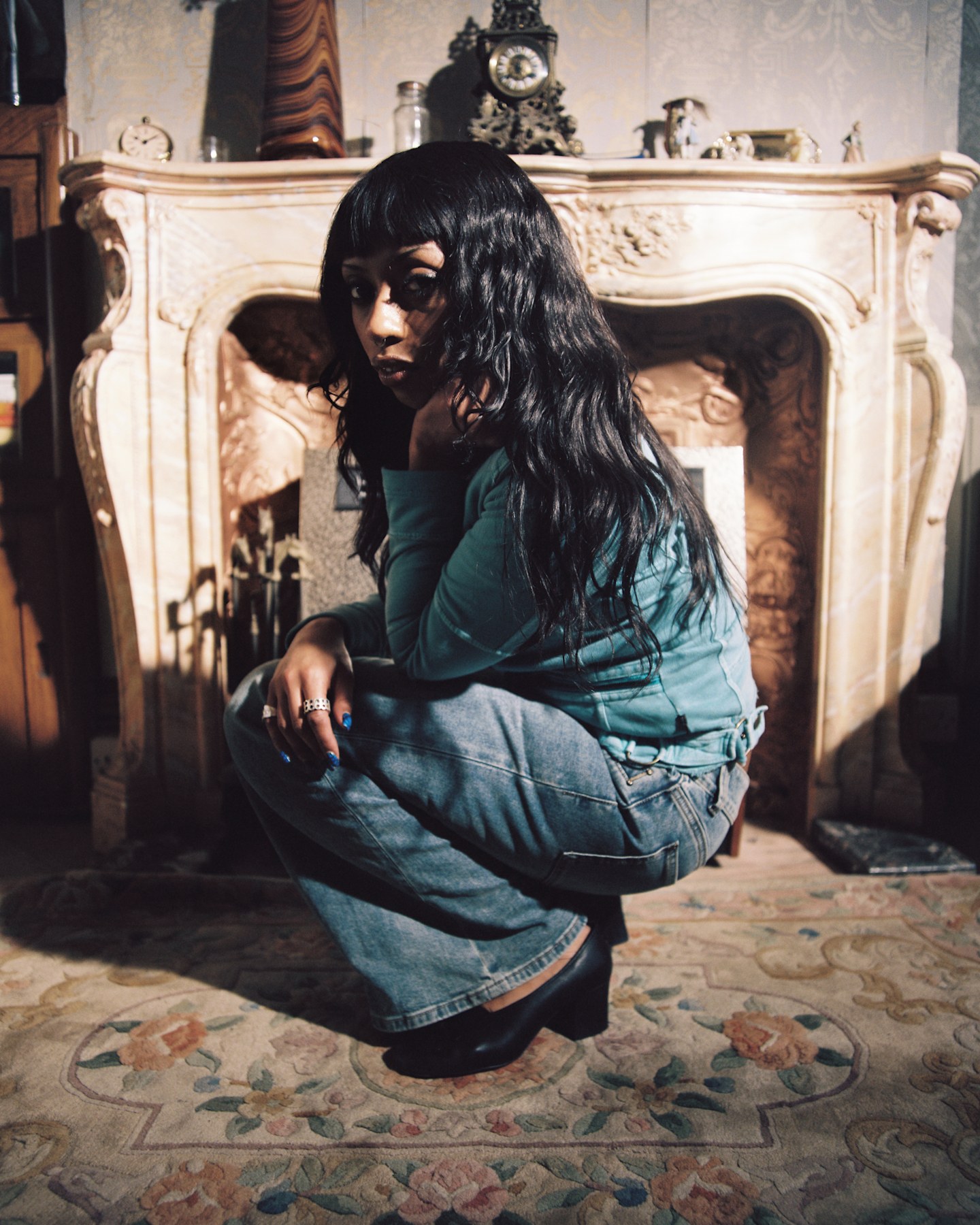 Stuart Nimmo
The distress and confusion of what had happened to her resulted in the sad half of Emotional Junglist, populated by songs with titles like “Lover’s Grief” and “The Darkest Moment,” which need little explanation. “Then finally I got to a point where I was like, actually, no, fuck this. How could anybody do that? ‘Boys In Blue’ is my middle fingers up song. It’s me saying ‘You’re a loser, and you ruined the situation.’”
Songs that fill in the gaps on the romantic situations of pop stars have been a theme in recent years. Lily Allen, Sabrina Carpenter, and Olivia Rodrigo have planted breadcrumbs of scandal in their song lyrics, adding a rubbernecking thrill for fans already deeply invested in their private lives. Nia says she respects that approach but doesn’t want her songs feeding the gossip machine in the same way. “I know it could be beneficial to me but I don’t really want to expose anyone and I’ve been trying to be as graceful about it as I can,” Plus, she adds, “I’m better than that. I’m so much better than him.”
I didn’t like being the centre of attention. All of a sudden I had people perceiving me.
It’s not just the sad songs on the album that’s making Nia feel nervous about her upcoming release. “Danger,” the most sexually explicit moment on the album, started in a writing session for Rihanna. The glossy and algorithm-chasing world of Los Angeles sessions hadn’t previously appealed to Nia but when Skrillex invited her to join the camp (exact details of which she is sworn to secrecy over) it was too big of an opportunity to decline.
Nia had never sworn on a song prior to recording “Danger” (a sample lyric: “Boy, you're too rowdy, fuck the sheets off the bed / And you got me pussy-blushing, make it turn bright red”) but right after she did, she knew she had to have the song for herself. “I would love for [Rihanna] to have the song but I didn't feel like she was actually going to release any music anytime soon,” Nia says. “That song was fun for me. It set off a new era of trying and saying new things.”
 Stuart Nimmo
Trying new things is important to Nia as she strives to become a fully realized artist. After years of performing only as a DJ, she will tour her new album with a live band. Earlier this year, she tried out the configuration at an intimate show at a church in Hackney, east London, which cemented her commitment to the change. “I fell into DJing and it's not really my passion if I'm honest with you,” she says. “I never really wanted to be a DJ and I didn't really want to be in a band either, I just wanted to make tunes on my laptop at home.”
Producing and writing is where Nia feels most at home. For Emotional Junglist, she challenged herself to write songs at different tempos, a move that she knew would force her to grow creatively. Helping her to build the album were songwriters Julia Michaels, Ed Thomas, and Livvi Franc (KATSEYE, BTS, Tyla), producers James Ford (Geese, Arctic Monkeys) and FKA twigs collaborator Ethan P. Flynn, plus guest vocalists Sampha and Jorja Smith.
“Nia has such a brave way of approaching music,” Sampha says of working with Nia in a video call. They wrote “Tender,” a stripped-back moment of longing that sits at the center of the album, in his London studio. Initially brought in as a producer, Sampha wound up singing on the song, too. “I naturally gravitated towards her as someone who is owning that jungle sound and mixing it with pop,” he adds. “I’m always drawn to someone with such a strong identity and a vision of her own world. It really stands out in the landscape of singer-songwriters.”
 Stuart Nimmo
 Stuart Nimmo
Standing out and doing her own thing has been a default setting for the Yorkshire native. She left home at 16 and moved across the country, staying at a youth hostel. She has little contact with her parents but remains close with her two younger brothers. “I'm proud of where I'm from but it was not an easy place to be,” she says. She’s grateful to her younger self for “being courageous enough to do something unbelievable.”
It would be easy to say that Nia found her community through music, though that isn’t quite how she tells it. She speaks about the importance of “feminising” the jungle music scene and expresses slight regret at the “hard, aggressive, laddish” way she feels her earlier music was presented. “If you go to any jungle rave it's a lot of men. Which isn't a bad thing, but I’m proud that a lot of my audience are women,” she says. “I'm definitely leaning into my femininity and it is for the girls. It's nice that there's a space where they can come party.”
She took a similarly forthright approach to things in 2022 when she criticized organizers of the MOBO Awards for dropping their electronic/dance music category. In an open letter to the awards ceremony organizers, she called out the lack of diversity. “How can we expect young Black people to see themselves in the music if our own organisations and award ceremonies won’t even celebrate the diverse range of talent that boldly exists in this country?” she wrote. The organizers listened and reinstated the award that same year, handing the prize to Nia herself.
I never really wanted to be a DJ. I just wanted to make tunes on my laptop at home.
Looking back on that moment now, she says it felt “necessary” to say “Black music isn’t just one thing and Black people aren’t just one thing.” Dance music is one of the biggest genres of music in the world, she says, and it would be wrong to “ignore this part of culture.”
In 2021, Nia solidified her commitment to jungle music by establishing Up Ya Archives, a party series and label she’s using to bridge the underground dance music world to the mainstream. By signing young artists to single-release deals and booking them on club-night bills, she’s hoping to establish a pipeline for bedroom producers to get industry attention and book more gigs. “Music is plagued with a lot of privileged people and it's nice to see artists doing well that maybe otherwise wouldn’t get that leg up,” she says.
With one foot in the underground, Nia is using her other to stretch beyond the confines of genre with her new album that, in turns, veers into smoother, punkier and poppier territory than on her debut. Does she worry about what jungle fans will make of Emotional Junglist’s genre detours?
“This is an alternative record. It's not a jungle record,” she says firmly. “People might not like that but I think it's fun to explore jungle and not just make the same song 15 times in a row. I'm not going to let the underground scene dictate what I should do.”
 Stuart Nimmo
It can be hard to get a clear read on Nia, an artist who at once is both deeply uncomfortable in the spotlight and unafraid to take a stand when she believes in a cause. She knows her album could alienate a portion of her raver fanbase but wants to do it regardless because she believes in her own artistic integrity. She says she’s in her “villain arc,” but adds that it just feels more honest when she’s trying her best to enjoy it and “not hate the process.”
The last time she had to force herself to just enjoy and not hate the process? It was 2023 and she was asked to open for Beyoncé on the London leg of her Renaissance tour. The invite came after Nia’s comments about the MOBOs, but by show day she was feeling a lot less brave.
“I felt really awkward,” she remembers. “I should have enjoyed it more but I was feeling so anxious and nervous I couldn’t speak.” Then five minutes into her set, something clicked and she loved it. “I'm screaming and I'm shouting.”
It’s in this seemingly contradictory state where Nia Archives fully embodies the artist she has always been. She feels terrified pre-show yet never more alive than when she is up on stage. She’s nervous being spotted at the bar but ready to push herself into uncomfortable places, all in service of being honest with herself. She might have concerns about where Emotional Junglist will take her but she already knows the truth: fortune favors the brave.
Nia Archives's 'Emotional Junglist' is out July 17.