Listen to a new FADER Mix by Octo Octa
A vinyl-only mix that channels the ecstatic energy of ’90s Chicago radio.


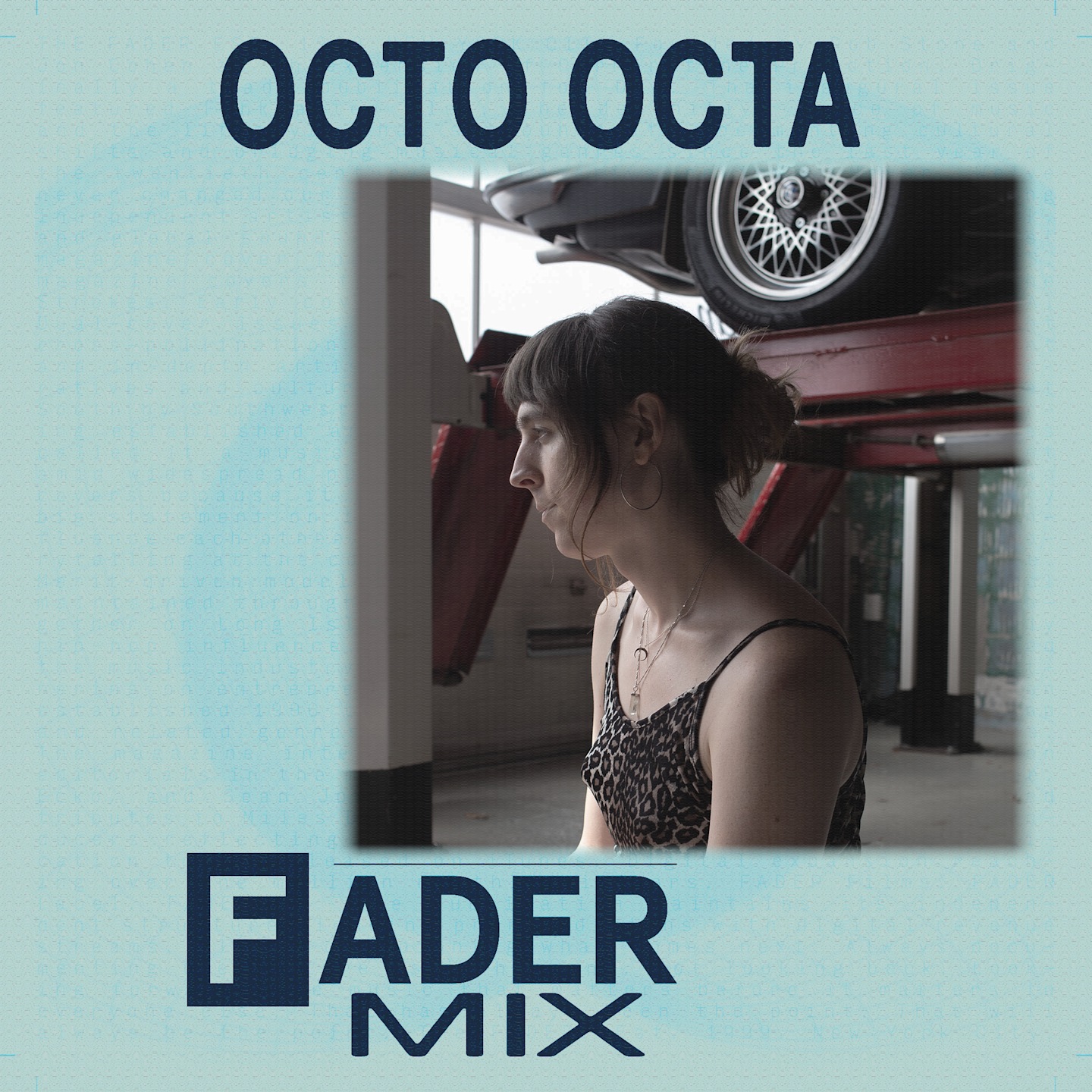 Photo by Marysia Swietlicka
Even though Octo Octa’s (Maya Bouldry-Morrison) FADER Mix was recorded in her quaint New Hampshire cabin, it vibrates with the energy of Chicago radio.
The globally renowned Chicago-born, New Hampshire-raised vinyl DJ and producer cites Chicago radio station B96’s street mixes from the ‘90s — which her partner in life and creativity Eris Drew showed her — as a key inspiration for this mix. “The Street mix is a ‘Saturday night dance party’ mix that the hosts put together,” Octo Octa tells The FADER. “[It has] lots of radio versions, tons of quick mixing from one track to another, hard cuts that would make me yell with delight when listening to it.”
That ecstatic energy can be heard and felt on Bouldry-Morrison’s FADER Mix, and across her entire expansive practice as a DJ and artist, like her work with Drew as the co-crafter of T4T LUV NRG — a label, party series, and generally expansive work of dance floor-based healing, that has become essential to the global scene.
An exemplar of excellence in vinyl mixing, Bouldry-Morrison’s sets are physical in practice and spirit, as her hand-guided selections sonically transmute into her reverent and hypnotized crowds. Her community-driven ethos and centrality to the trans and queer global dance community lends her joyous musical creation a necessary political edge. Bouldry-Morrison cites the likes of MX Blaire, Kiernan Laveaux, CCL, and Introspekt, as well as “the wider queer community [which] seems to be making more space for itself.”
Listen to Octa Octa’s FADER Mix on Apple Music, Soundcloud, Youtube, and Mixcloud. And check out Octo Octa’s FADER Mix tracklist and read an interview with her below.
Octo Octa's FADER Mix tracklist
The Mackenzie, "Chicago Trip" [MacKenzie Records] 1989
Cartouche, "Feel The Groove (Sergosonic Mix)" [Scotti Bros. Records] 1991
Pizarro, "New Perspective (Techno Mix)" [Razz Enterprises Inc.] 1991
D.M.S. featuring Von Black, "Don’t Stop It (Extended Dance Mix)" [Cutting Records] 1991
Earth People, "Dance (Club Mix)" [Champion Records] 1990
MIxx Vibes, "Blind Scat" [Vibe Music] 1993
Sound Factory, "Good Time (Pure)" [Logic Records] 1993
Cappella, "Big Beat" [International Dance Records] 1994
The Shamen, "Move Any Mountain (The Bonesbreaks Mastermix)" [Fokus Recordings] 1991
Antwerp Express featuring Slam, "Get On The Groove (Instrumental Mix)" [Raiders Records] 1991
Amok, "Tubular" [D-Vision Records] 1994
How II House, "Time To Feel The Rhythm (Def Party Mix)" [Bigshot Records] 1989
LDV, "Climb The Wall (Mix 2)" [Music Man Records] 1992
Frankie Bones, "Jack Your Body (Retro Tech Mix)" [The Groove Shop] 2006
DJ Tonka, "Feel Phun-ky (The Handyman Mix)" [Outland Records] 1996
Yo Speed featuring Jose Rodriguez, "Make A Beat" [Distortion Records] 2022
Swift, "Feel Good (V.G. Network)" [Club Tools] 1998
Kellee, "My Love (Ralphi’s Revenge)" [Moonshine Music] 1995
Cado & Jinx, "Anthem" [Blue Sim] 2024
Hardrive, "Deep Inside" [Strictly Rhythm Records] 1993
Da Rebels, "House Nation Under A Groove" [Clubhouse Records] 1989
 Photo by Marysia Swietlicka
The FADER: What led you to start DJing?
I got my first set of turntables in 2000/2001 (Numark Belt-Drives) when I was a young teenager, around the same time I bought my first drum machine (a Korg Electribe ER-1). I wanted to DJ badly but didn’t really have record stores that carried 12” singles where I grew up and I didn’t have friends who wanted to go to a record shop. So other than some mail order and occasional pick-ups when visiting a city as a teenager, I had a hard time getting records to DJ so I put my focus into making dance music instead.
Fast forward to 2010 and I’ve moved to Brooklyn and finally had access to record stores and started to really collect records. A year or so later I picked up a set of Technics 1200 MK2s and started to practice and a few years later when I had more confidence I started to DJ out at clubs.
What was the first set you ever played?
My first performances were in basements and rec halls as a teenager playing electronic live sets with friends. My first DJ sets would have been in Brooklyn playing back room dance floors in bars or in venues like Bossa Nova Civic Club with my friend Kellam Matthews.
One of the first DJ sets I ever played was in 2013 at Mercat in Melbourne while on tour with my friends Magic Touch and Bobby Browser. I didn’t bring records with me so my friends convinced me to try playing on CDJs and either we burnt some CDs or I used their CDs to DJ that night with them. I had the best time and returned home wanting to focus some more on DJing. Mercat was a special club.
 Photo by Marysia Swietlicka
What DJs or artists inspire you?
My partner in life and music, Eris Drew, is forever my close collaborator but she is also my muse. Having someone who so thoroughly wants to talk about all things music and also learn more and more about techniques to better our craft means the world to me. I wouldn’t be the artist I am all these years later if it weren’t for my work with her!
How has your local scene shaped your mixing and curation?
I live in the woods of New Hampshire which does not have a local scene for this music, but there are a number of people I admire who I have known for years that inspire me constantly like MX Blaire, Faited, Beige, ADAB, Kiernan Laveaux, Russell E.L. Butler, CCL, Introspekt, Colored Craig, Ketia, Fafi Abdel Nour, Justin Aulis Long, to name just a few people. The wider queer community seems to be making more space for itself and I feel there are a lot of impactful artists that are coming out of these spaces.
What’s the most memorable set you’ve ever played?
One of the most important sets I’ve ever gotten to play was in 2018 when I asked Eris to play with me all night for a residency at Good Room in Brooklyn called “Frendzone.” Eris and I were starting to get booked on line-ups together but separately. That night was the first time Eris and I really DJed together and it was for eight hours. It was such a heart-connected night that we planned to do it again. That led to us starting T4T LUV NRG originally as a party series.
What excites you about the future of nightlife?
I am not a vinyl-purist, but I do only play records and I highly encourage young DJs to learn the skill as well. Even if they don’t play records out, having the skill to mix records will only make them a better DJ. Previous years have been lean when it comes to vinyl DJs, meaning that I don’t see records being played out too often. What I have recently found so exciting is that I have now met lots of young, typically queer, DJs who also want to play records. That gives me a lot of hope :)
What DJ trend needs to end?
Saying there are too many DJs. As long as someone wants to invest the time and energy into working in this art form then I want everyone who wants to do it to do it. Creative fields do not have occupancy caps; if something creative inspires you to want to do it then go for it!
How would you describe your FADER mix?
This is me channeling the B96 Street Mix. I was born in Chicago and spent the earliest part of my life in the suburbs before my family moved to New Hampshire. During that time the car radio played an important role unless you had a tape deck in the car so a number of stations were imprinted into my brain as a young girl. B96 was one of them. Fast forward to meeting Eris, she starts going on YouTube and begins pulling up all the uploaded tape recordings of the B96 Street Mix that people saved from the 90s. This delights me because it reignites memories of Chicagoland radio stations for me. So this mix points to that.
Where did you record the mix? Describe your surroundings
I recorded this in my studio at home. I live in a log cabin with Eris in New Hampshire. My studio is on the second floor in a lofted area and the windows look out on the forest in the backyard. It’s finally spring here and I have the windows open after a long winter here at home.