Navy Blue on Sir Render, Na-Kel Smith, and how “simple is a strength.”
On his newest album Sir Render, Sage Elsesser’s pen is sharper than ever. It only took him five years.


 Ethan Holland/The FADER
Navy Blue won’t say Sir Render is his best album yet, but it is the one he’s put the most thought into. That makes sense: when you work on an album for five years – and you’re as creatively diligent as rapper, model, and skateboarder Sage Elsesser – of course every word and instrument will be considered just so. Elsesser has been releasing pensive music under the moniker Navy Blue since February 2019, and so his latest full-length presents a cumulative snapshot of his career in the 2020s. And although Elsesser demurs to pick a favorite from amongst his albums – “they all serve their purpose,” he tells me the first time we chat – his pen has sharpened vividly on Sir Render.
This clarity of writing is framed by a series of spoken word interludes of James Earl Jones narrating the 1940 novel Native Son by Richard Wright. Jones is a second or third cousin of Elsesser's through his grandmother, and supported Elsesser’s mother pursuing a career in the arts, making it a full circle moment for the family.

Read Next: We decoded Camp Flog Gnaw's 2026 lineup
“James Earl's candor and how his phrasing is so different, it just gave the album another life,” says Elsesser. “It felt like I was honoring him, and I was making this album when he was alive. Now since he's passed, it has a whole different meaning and purpose.”
Elsesser doesn’t edit his raps: “People say the first idea is generally the best idea. That feels like God's will for me,” he explains. “The first thought is what it's supposed to be, versus me getting all into the minutiae of it and being like, no, but what if...” Through experience and curation, Sir Render feels remarkably efficient, in the sense that every cutting line feels carefully considered and calibrated, honed to a pristine edge. Elsesser is quick to credit the late Ka as a key inspiration, explaining that the Brooklyn MC always knew when to leave, “the space for breath.”
“Give the listener time,” Elsesser says. “I’m a film person; I like jarring stillness. I like when a shot is held a second too long. If we were to sit here and just look at each other and not say anything – who's gonna be the first one to break? I want to push that moment, that feeling right when the scene should be cut and there's two extra seconds. I’ve learned to embrace that”
The FADER caught up with Navy Blue two days ahead of the release of Sir Render to chat about simplifying his raps, working with Earl Sweatshirt and Na-Kel Smith, and the meaning behind his lyric, “living through a genocide as real as it gets.”
The FADER: Talk to me a little bit about what you've been doing these last couple of days leading up to the release of Sir Render.
Navy Blue: I actually just got back from London. I went out there to celebrate with with my extended Arsenal family. Winning the Premier League after 22 years, it was a necessity for me to be there. So, that's where I just was at, after a heartbreaking Champions League final loss. But, I’m content. Preparing to let the world have an album that I've held near and dear to me for the past couple of years, and I'm just happy that it's going to finally be released.
Your music is really about emotional landscapes, our internal psycho-geography. But one line that stood out to me on "Belladonna" with Earl Sweatshirt was, "From Mid, out to Bed-Stuy." When I listen to your music, I don't necessarily think of you as a person from a specific location; I think of you as somebody whose music is more about us seeing the world through your eyes. Talk to me a little bit about how these physical locations register in your music.
From a two-dimensional aspect, I always think in extremes, and I think of two ends of a spectrum. As I've grown up, that two-dimensional line with two points on each end has looped around and made a circle, and then that becomes a three-dimensional thing, a sphere. So from the two-dimensional plane, I just see it as like two coasts, my beginnings and my present times.
"From Mid-City out to Bed-Stuy, from depths rising." It's a simple, simple statement. But yeah, Mid-City is where I'm from, it's where Thebe [Earl Sweatshirt] is from. We have that shared bond and love for where we're from in Los Angeles. There's a part of me that feels like I really became who I am, who I was truly meant to be here in Brooklyn. And I mean, Navy Blue really blossomed as a project in Bedford-Stuyvesant specifically. So my heart is always kind of here in that sense.
One thing from our previous conversation I was thinking about a lot with this record was the idea of saying more with less. One of the big developments in your writing on this record is that it feels like there's a real efficiency of images or ideas, whereas previously there was a bit of intentional meandering. How are you thinking about this idea of reducing down?
I just think simplicity always wins. At the time that I was beginning to make this album, I had set my intention. Not that I had created confines or limits to where I could go: I knew specifically what I was trying to speak to. I knew the time that I was speaking to. I knew that I wanted to make an album that was an extension of Song of Sage: Post Panic!, but from a different lens. Reflecting back upon it, having a new experience with old experiences. That's part of growth.
I remember being in high school like, "Oh, I hate this, I hate this." I was in a boarding school, and then now as an adult, I'm like, “What the hell? It was so beautiful, I'm so grateful for that teacher, that experience,” and that's just perspective. So I also know that I was deeply studying Ka's work, and I always felt that the absence of words and the space that he would use between moments would accentuate that kind of... Mm, I'll give you an example. Breath and the absence of words is also saying something. You know, people revere Bukowski, and he's one of our greats, but he's quite a simple writer.
Simple is a strength. Simple is not necessarily easy. There are basketball players that I grew up watching, skateboarders that I grew up watching that made things look simple – but it's not.
 Ethan Holland/The FADER
On the record you rap, "Living through a genocide is real as it gets." What does that line mean to you?
This is something that Thebe and I have spoken about in the past. You write something in the present, and you don't know what you're writing about until the future. I was speaking about the genocide of Black Americans, and then lo and behold, look at the times we're existing in now. Witnessing a genocide right before us, and being as desensitized as we already were. The rude awakening.
I'm just grateful to be someone who feels the way that I do, that I have a heart still. When I see those images of mangled infants, and that makes me feel choked up, or when I see a child here in America whose life has ended much too soon, that I feel moved by that. And that I feel a duty to live in their honor.
So when I say, “living through genocide is as real as it gets,” witnessing death and living is painful. Why do I get to live, and why does a child have to die? Since when did martyrdom apply to children? But I love writing. That's the power of writing. There's people that wrote in the '40s speaking of this, and their work still stands today. And that's the power of the word. So you also have to be really careful about what you say and what you write.
I also wanted to ask about your friendship with Na-Kel Smith, another talented skater who made the jump to rapping.
Much like Thebe, Nak is somebody that I’ve always looked up to. Whether it was how to wear my clothes, how to tie my shoes, I always looked to Nak for that inspiration as a child. I got to witness Nak step into his gift that is the way that he writes, how poignantly he’s able to speak to his life. I feel like we come from that kind of tribe of, “here’s a snapshot of my life presently. This is how I’ve grown.” And Nak has witnessed that with me as well, stepping into music.
Being that I’ve known him for so long, it’s really cool to watch him make his own beats. I think that's where the real magic is, when you start making your own beats. Only you know what you’re looking for truly. And he’s made some special music that I think is kind of ahead of its time. People will come back to it and be like, “Whoa, this is something that we maybe weren’t fully appreciating.” I think that applies to so many people that I love.
One of my favorite lines from the intro track was when you said, “My mother didn’t give me life to pick it apart.” And I was thinking about “Life’s Terms” from 2023, when you rapped, “I put my all in this to pick apart these flaws I wear.”
Both can exist, you know? One might have been written on a Tuesday and the other on a Thursday. There are days that I’m hypercritical and I’m thinking about how I could have done something better, or in a more heightened sensitivity. I would say on “Commencement,” when I say that line, “Mama didn’t give me life to just pick it apart,” it’s like a reminder, you know? Cuz I’m still liable today to sit there picking apart things that are perfectly imperfect. And that’s what this album is really about, accepting one’s shadow. All the parts we need to work on.
The reality of that is that you’ve got to learn to accept it and live with it, because the parts of us that we necessarily don’t like are still parts of us. We are complex people, you know? All of us , whether we know it or not. But I also think that we are much more simple beings than we think we are. We think that things are much more complicated than they are, but that’s just how the brain works.
The analogy that I was using for some years is like, if you’ve ever worn two to three necklaces, what happens when they get tangled? That takes patience. You have to go really slow, otherwise you’re just going to tangle it more. So I guess I’m speaking to whatever that feeling is there– slowly picking one link at a time to undo it versus just like [makes frantic noises]. It’s really easy to panic. But it takes true composure to be able to just say, “All right, today I’m not going to, you know, pick myself apart and be and be cruel to myself. I’m going to make a conscious effort to just be as loving and and compassionate as I can be,” you know? That's how I reflect on both those lines.
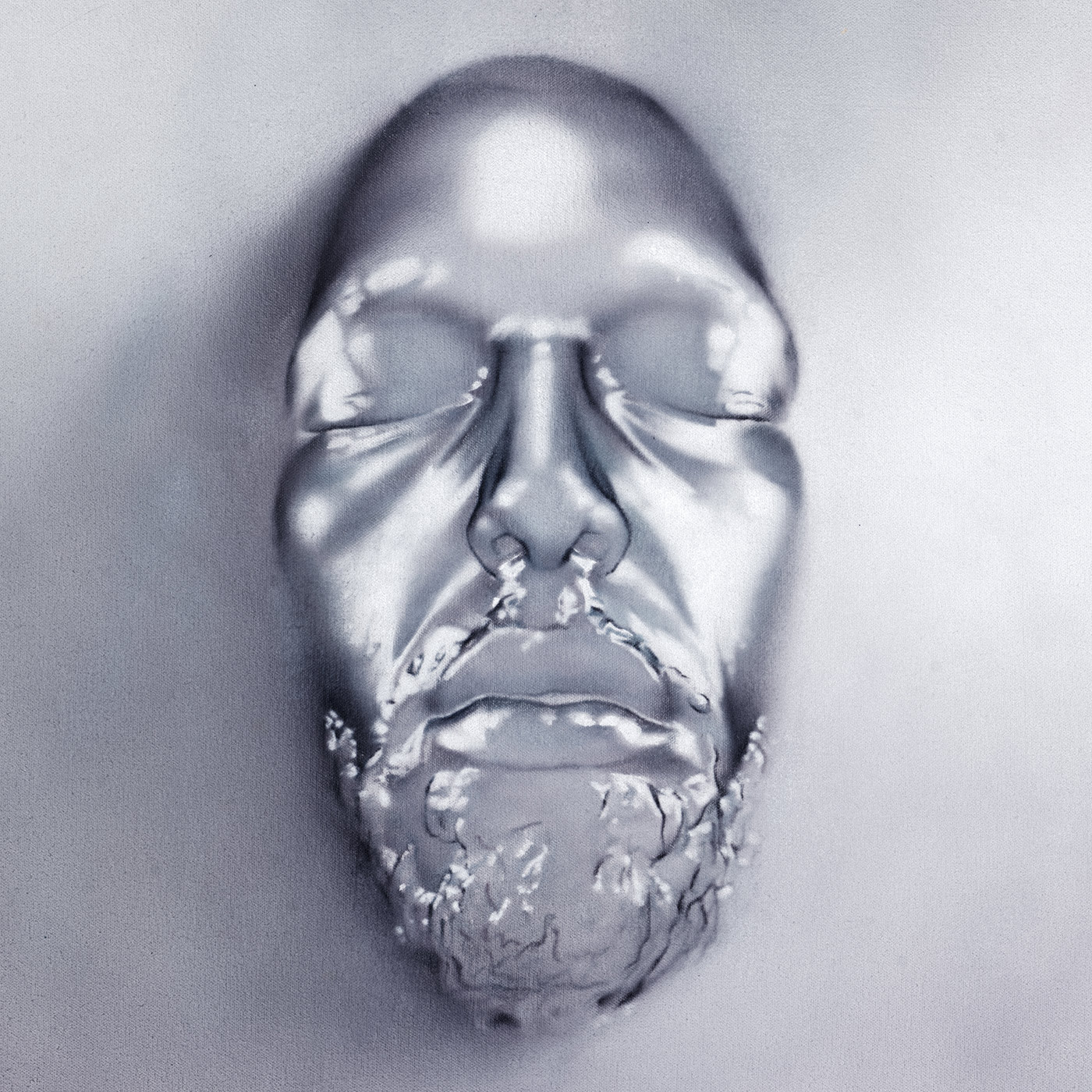 The album art for Sir Render by Ryan Lee.
You've been working on Sir Render for five years. I was curious about that because that spans your time before, during, and after signing to Def Jam. Could you talk a bit about the decision to go to a major label and how that influenced the music that came after?
I love Ways of Knowing. That’s an album that I will always love and appreciate. But working with Budgie was the first time I'd ever worked with just one producer, and I think the first draft of that album was much more in line with the music that I was making. And then there’s certain joints that didn’t get cleared, and we’re having to remake them. And then these songs are becoming big and I’m thinking, “Whoa, maybe this is an opportunity to really breakthrough and reach a new audience.” And I’m really grateful for it; I tried a lot of new things on there, but I just felt this necessity to return back to my essence.
None of it was in vain, I wanted to learn how the machine worked, and I definitely got to learn how it worked. It’s definitely not for me. I make music from my heart for the people that it’s meant for, and when it’s funneled through the computers and all of that stuff, a part of it dies, you know? Part of the spirit dies. You have to be content with that.
I remember my mom saying she met Marvin Gaye and they were like, “Yeah, I’m a singer, I’m gonna make music dadada” and he said, “Well, you better love it because it’ll kill you.” And just thinking about all the tortured souls of the music industry, everyone knows that it’s maybe not the most wholesome place. Although I didn’t get too engulfed in it, I had enough of an experience to know like, “Ah, this is not this is not the place for me.” Independence is definitely the way to go right now. The traditional record label setup is just, if it works for you, then it works for you. I know for me personally, it doesn’t work for me.
You and Budgie locked in on Ways of Knowing, which had a bit of a different sound. After you were dropped by Def Jam, it seemed like you had a bit of a creative or internal shift.
Nothing happens in God’s world by mistake, and things are exactly as they are meant to be. Like: grateful for Ways of Knowing ‘cause I would have put out something else. And Sir Render wouldn’t have come out when it needed to come out, and then we wouldn’t have gotten Memoirs in Armour and we wouldn’t have gotten The Sword & the Soaring. So I’m just content. I look up to wherever God is, and I’m just like, Thank you. You’re in charge. I’m just here moving the needle a little bit.
 Ethan Holland/The FADER