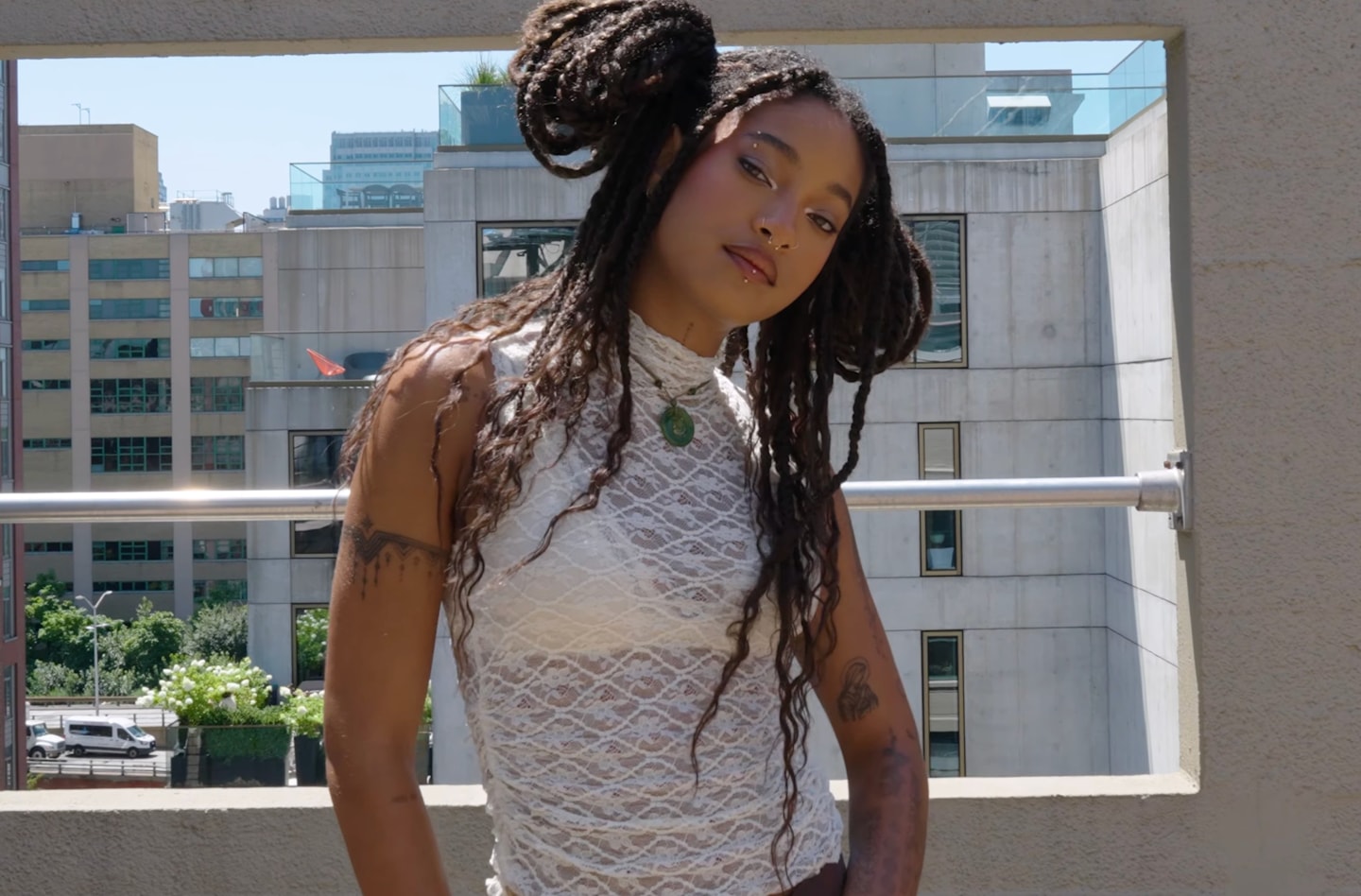


"When people listen to my music or they come to my show, I want it to feel like they're literally being healed from the inside out, like it's a spiritual, shamanic experience."
This is what 25-year-old WILLOW says when she envisions her end goal as an artist, singer, songwriter, instrumentalist (and the list goes on). For her, delivering a spiritual experience goes hand-in-hand with achieving peak physical performance, sharpening her skills as an artist to the point where her ability and performance can become tangible enough to move a person. "It almost reminds me of what I imagine ancient Greek people used to feel like in the old Olympics. This is what humanity can do!"
For the past decade and a half, WILLOW has been diligently chipping away at this mission: publicly, through the release of nine studio albums, but also privately, through the nurturing of a widely varied and disciplined artistic practice that's included taking up the bass, drums, piano, and cello, and following every esoteric music theory rabbit hole that crosses her path. Since breaking out in 2010 with "Whip My Hair," WILLOW's musical sound has moved through R&B, neo-soul, pop-punk, and rock, all of which served as training for the ambitious sonic palette she's mining now: one rooted in progressive jazz and that embraces a dense musicality.
Her latest album, The Thread, is a culmination of this heads-down practice, a 10-song record of nimble instrumentation, rich stacked harmonies, and insane runs and riffs. There's a masterfulness to the music, where you can notice the complexity of the arrangements but listening still feels effortless.
WILLOW came into The FADER office to discuss the evolution of her music practice and her thoughts on the state of the world, tech, and her hope for the future. Watch the conversation and read a transcript of the interview below.
The FADER: How are you feeling, WILLOW?
WILLOW: Oof! That's so crazy just hearing you say that. Ninth studio album.
What a journey it’s been.
Wow. I am just so grateful to be able to put two records out this year, which is something I've never done before in my entire career. Very daunting, but I don't know, I have a lot to say, and I feel like it just feels right, right now.
Yeah. I feel like both records — and we'll get into this a little bit — but they complement each other really well, I think. Like two sides of you growing into yourself as an artist.
Yes. 100%. Petal Rock Black came from a place of like me challenging myself and being like, “Okay, like, you've been practicing, you've been studying. So now let's see what you can do when you put yourself in a room with the piano, the bass, the drums, and the guitar, and let's just see what comes out.” Many a days recording that album, I was like, I feel like I'm scratching the bottom of the barrel here in terms of my creative ideas, but also my technical abilities. I feel like when you're scraping the bottom of the barrel, the bottom of the barrel gets bigger in terms of what you have to draw from creatively.
And then The Thread, on the other hand—shout out to my good homie Chris Greatti, this is our third album that we've made together. Our first project was COPINGMECHANISM, second one was Empathogen, and now this one, The Thread. It's so interesting going from having so much pressure on myself every single day walking into the studio and being like, almost a little bit afraid and anxious, like, "Here we go. Like, what's going to come out today? I hope it's something I can use!" But then walking into the studio with, you know, my really good friend and collaborator, the sense of ease with our support of one another, and me knowing his strengths and weaknesses, and him knowing my strengths and weaknesses, and us being able to…
Work together.
Exactly. And it felt just like a breath of fresh air after really scraping the bottom of the barrel for like two and a half years.
I do want to rewind a little bit and talk about Petal Rock Black because I think a lot of people don't know the challenge you put yourself through. You played almost every instrument on that record. You wrote and recorded alone, except for an engineer.
My engineer, good friend, shout out to Adam Schoeller. Love you, bro.
It almost feels like a — I don't want to say a torture session, but like...
Bro, yeah! Yeah! I'm so glad that you...
What inspired you to be like, “Okay, let me put myself through this insane challenge?”
I was going through a lot emotionally, and you know, collaboration is amazing. Like, it's one of the deepest ways to create something beautiful, but I just felt like in order for me to really become the musician that I really want to be, like listening to Prince, Stevie Wonder, you know what I mean? I am setting a pretty high bar for myself. I feel like in order for me to be able to move forward on that journey, I really wanted to see, What can you really do? Let’s see what you can really do when no one else is like, “Hey, maybe, maybe it should be in three. Maybe we should make the kit go like this. Oh, I really like that idea.” Because we love collaboration, it's awesome. But sometimes the purity of your idea can, not get lost, but it just becomes something different when other people are there to be like, "Maybe it should be like this," you know? And to be able to just see the purity of my vision, and to be like, "Okay, what is really there?"
To see your true baseline.
True baseline. Of like, “Okay, I’m not playing video — I’m not doing videos on Instagram, this is like a full album!” You know what I mean?
So how do you feel about the result?
Obviously, you know, listening back, already there are things that I would be like, “Okay, I would change this here and there.” But that’s why we love albums and that’s why we love listening to artists’ older music, because it shows their growth, and it shows places where unexpectedly different creative sparks arise that then come back later in odd ways. But I don’t know, I feel like most of my favorite artists have that capability of being able to go into a room with instruments and create something uniquely themselves. And I was like, “This just needs to become a practice for me.” Like every two years, or every, I mean every year, that's a lot, I would love to get to a point where I could do that.
I feel like when you’re scraping the bottom of the barrel, that’s how the bottom of the barrel gets bigger.
To create something completely by yourself?
And that being a recurring thing that happens over my career, because then you really get to tap back in. Now when I do another collaboration, I'm going to be extra solid in my ears and my capabilities and my technical abilities. 'Cause sometimes, we can go into rooms with really amazing musicians, and this has happened to me so many times where I go into a room with a really amazing musician and they're like, “Oh, it should be like, or maybe it's like, or maybe it's like..." And I'm like, "Damn, I wish, like, I feel like I'm not following you." And I hate that! Like, I want to be right there with you and be like, "Oh yeah, what if it was in three? And then, oh, it could also..." you know? So it's also a pursuit of wanting to be able to communicate with other musicians and play with other musicians that I really respect as well.
I feel like the language and being able to speak technically, that's a hard skill. Not a lot of musicians or singers or songwriters have that.
Yeah, and being able to say your idea, yeah.
I do want to talk about collaborators, because throughout your career, you've worked with such a wide range of people, and on The Thread, your only feature is the amazing Mei [Semones]. We love Mei.
Right.
For people who don't know, she's this virtuosic guitarist in Brooklyn. And as soon as I heard that song, I was like, “I think that's the song that Mei is on,” cause her style is just so distinct. I read that you got in touch with her just through DMs?
Yes.
What are you looking for when you are looking for a collaborator? What made you be like, "Oh my god, I need Mei for this project"?
Well, I had been listening to her music for many, many months before I contacted her. And I was just soaking in her sense of melody and rhythm and, it's not very often that you come across an artist like Mei. You know even her look, her style, and the way that she presents herself is very, um... Miles Davis said something really interesting, he said—can I curse? I don't know if I can curse.
Yeah, go ahead, please!
He said, "A motherfucker got to look like he play."
Correct, yeah.
And it's like, if you're going to come into the space wearing khaki pants and Crocs, you know, I might not be like… I might not look at you and be like, "I want your energy in my band." Or I might look at you and be like, "Are your chops khaki pants and Crocs as well?" You know what I mean?
The vibe is important.
The vibe is very important. And Mei comes into the room in her power and her, you said virtuosic, in her virtuosity. And she's just so inspiring. And that's really what I'm looking for in a collaborator, is somebody who inspires me to dig deeper into who I am as an artist. Iron sharpens iron, you know what I mean? I'm always looking for that, for that kind of situation.
What was it like working with her on that song?
It was amazing. I mean, ah, I kind of felt bad 'cause she was so busy, and she was in L.A. and just doing so many things. And so I tried to make the session as easy for her as possible. I had been listening to her music for so many months before, so I felt like I had a really good idea of maybe the kinds of chords that she would like. And so I did a rough sketch, and I left a section for her to just do whatever she wanted with. And that's where, that's the section of the song where everything cuts out and it's just the guitar, and it's um, "I kissed desire and I called it grace." And that's the part that I was like, "Take it away, Mei!" That was amazing. Just so easy, you know? It's beautiful when you can work with someone who really knows who they are, because then there's not a lot of like, “Oh, well, should it be...?” It's like, no, we know what we're trying to do here, you know?
Something about this record, and I feel like maybe a lot of people feel it, is it just, it does feel like a culmination of your artistry, and like you finding your niche. I feel like a lot of it started with Empathogen. Maybe this is just me coming from the outside, but it did feel like there was a change in your artistic practice where you were, you know, embracing complexity, embracing denseness.
Yes.
I'm curious, what happened between
I was in a really interesting position before I met Chris. I was just kind of like, "Ah, man, like I'm trying to find that next creative spark." And Chris came into my life, and we started recording
After that, I was so interested by that harmonic structure and how that works that I did a course online. I actually took a college course on functional harmony before I started recording Empathogen. And I don't work like, I'm not like throwing out chord names and, you know what I mean, saying all that stuff. I don't really work like that. But just having that in my space, and that being an everyday practice for me, I feel really went into the making of Empathogen in a deep way. And it's so interesting, I love that it shows, that you can hear it, you know what I mean?
I want to talk about this idea of practice, because you've brought it up, I read your New York Times piece today that came out. You had this really great line that I think a lot of people who aren't musicians can take some wisdom from, but just the value of practice. You said something like, “I learned recently that the only thing that I need to do is practice and work on my instrument."
Yes!
What does your music practice look like on a daily basis?
Because my mind works so musically oriented, like you, it's really great to be able to sit down and do scales, and there have been moments in my life where I have done that, and I'm going to have to do it again and again! But right now in particular, I'm more zeroing in on specific songs, like listening to Ella Fitzgerald songs, or transcribing her scat solos, or listening to some Wes Montgomery guitar lines and trying to learn that. Right now it's me zeroing in on specific artists, or Tigran Hamasyan. My drummer just put me on to Tigran Hamasyan the other day.
I have no idea who that is.
He calls it punk jazz, that's what Tigran calls it. And it is punk jazz. It's really out-there music with a lot of complexity and harmonic dissonance. But I've been jamming that, and even listening to Mei's music and analyzing her shit and learning those lines, that's been my main thing recently.
What is your primary instrument that you're playing? Still guitar?
I would say that my voice is my primary instrument. And I was just talking the other day, I was like, I've had the same vocal coach since I was eight years old. There are times where we’re really working, like if I have a big tour to go on, or if there's something specific I'm trying to learn how to do with my voice. But I was like, "Damn, I need to hit up..." Tim Carter, I love you, bro! I was like, "I need to hit up Tim and and do some more lessons," because like, it's been a minute. I never want to get on the slack vibe. I always want to be keeping my technique good. But I've been focusing on other instruments so much that I… I’ve been singing and I've been learning the shit, but when you really tap in with your voca, it's different.
What other instruments are you playing. Drums, bass?
So, guitar, drums, bass, piano.
Any instruments that you want to learn?
I wanted to learn the cello, and I spent a year and a half on the cello, and I fell off. I hate that! I hate that so much! But yeah I feel like I need to just chill and focus, because trying to spread my time across so many things, that's the curse of wanting to do everything. It's like, "Oh, so you're not going to spend three hours practicing on one thing, you're going to spend one hour practicing on this, one hour practicing on this, and one hour practicing on this," which isn't as potent as "I'm just going to spend all my time doing this." I need more organization on that front, if I'm going to be honest with you.
I want to talk about the themes on The Thread. As I mentioned, I was at your listening party last night, and the topic came up about the desire to connect with people, which is throughout the record, but also this idea of wanting to extend empathy and compassion to the people around you. There's this lyric in the album where you say, "Compassion is the medicine we seek,” positing it as the solution to this distance we're feeling with each other nowadays.
100% yeah.
How do you think we got to this place where empathy and compassion feels rare?
This is my hot take. Okay, are you ready?
Let's hear it.
I think that humans, we've strayed so far from human nature. Like, not a fan of zoos, but even at the zoo, you see every animal has a different habitat. The way that the plants are, the way that the ground is, every animal has a different thing because animals need different things, because they come from different places on Earth, and their bodies are made of specific nutrients that, you know what I mean? Every animal is specific, and humans are like that. We have needs, because we're animals. And one of our needs is we need to feel seen, we need to feel protected on some level, and cared for on some level. And we've strayed so far from human nature that with my music, I'm always just trying to bring us back more toward human nature energy. We're completely and utterly consumed by this idea of progress and expansion, but not the kind that's beautiful and blooming, the kind that's cancerous and weird, you know?
Exploitative.
Exploitative and violent. And that is not our nature, and there are people who benefit from us living that way, and it just turns out that we're in a space in time where they're the ones who are kind of on top right now, you know what I mean? But as artists, we're always trying to steer, steer the minds and the hearts of this beautiful human animal towards our nature, which is to care for one another and create systems of mutual aid and creativity and community. That is really what human nature is, and sitting around the fire and telling stories and singing and, and hitting the drum, you know what I mean?
Does that feel like one of the biggest callings for you, creatively, as an artist? A responsibility to steer people toward these innate needs?
Yeah, 100%, because an animal doesn't lash out with aberrated behavior if all of its resources are taken care of. An animal doesn't do weird shit if their environment is what they need it to be. If their environment is not what they need it to be, now, things start going on and some darker turns might take place because the animal is trying to survive. And humans are just in a really precarious position right now where our resources are not getting taken care of, and a lot of people are suffering, and that's pushing us into a direction where we need to be reminded more and more of who we are.
I would love to hear your thoughts on the role technology plays in this, cause I see, even while you're speaking about, you know, nature and the organic world, the complete flip of that is tech, which is where we're headed right now, and the embrace of, not even just AI, but social media.
Yeah. We're going to have to get really disciplined with the way we use our time, because these things are happening. Like, it's not like they're coming. Like, they're here. So now the only question is, who are we going to be in that environment?
That's what we really need to be focusing on, and we need discipline not to let these crazy forces that are, where we're living amongst, just rip us off of our path and completely fling us into cosmic space. This might be a another hot take, but obviously issues and unethical things lie in the technology itself, but I would even take it further as to say it by itself is not necessarily the problem, it's the way that humans use it, and the way that we delegate it out to who gets to use it, in what ways and how intense that usage is, and what the resources of that usage are. Where is that taking away from, in turn, for these people to use it? I think that's what we really need to be thinking about.
Miles Davis said, “A motherfucker got to look like he play.”
Do you think there's a sustainable way?
I think there is a sustainable way, I just think there's not a lot of energy being put into that conversation of trying to figure out like, “Okay, all of this is going on and it's terrible and it's bad and we don't like it. Okay, great, but let's go into proactivity mode.” Where it's like, “Okay, we have these resources and they're being used in not a good way. How can we use our brains to try to come up with our weird, smart ideas of how to combat that?” Because it's also all about knowledge as well. I'm not a coder. I'm not sitting here figuring out how to code stuff, but if I did, maybe I could figure out a more sustainable way to do this.
With your determination, I feel like you would.
Bro! I'm sticking to trying to steer us towards human nature in the music. I can't be coding now! I'm like, "Bro, I cracked the code, literally!"
Do you have hope? How hopeful are you these days?
I think about it like this, right? When we were back in the day, like back, back in the day, like before culture even existed and we were just out there with the elements trying to survive and keep ourselves together. We were probably like, "Oh my goodness, tomorrow is not promised. This is really scary. I don't know if I have hope." There's no iPhones in the scenario. There's no political overlords! In this scenario, all there is is humans and the natural world, and we're still in that position of feeling like maybe not have a lot of hope, as well, you know what I mean? So I don't think that hope is the thing to have.
I think the thing to have is a sense of pinpointed awareness of, what do we want to be doing with our moments? Because thinking about, "Oh, do I have hope for the whole thing?" I don't think that's the right question to be asking. I think the right question to be asking that we can use is, how in every single moment am I creating an environment that is accepting and loving and is more geared towards human nature? Sometimes that's really hard, 'cause sometimes some weird shit is going out there in the world and it's like, "Am I going to say something about this? Am I going to stand up and try to steer this moment towards human nature?" You know what I mean? Really courageous people do that. Greta Thunberg is doing that. You know what I mean? There are people who are doing that with their lives, and we just should be thinking about, what's our way in our moments that we want to be steering our environments towards human nature?
I want to end on a more positive note.
Yeah, let's do it, I love it.
Given the record and where you are, it feels like you're just on this path of growth and progress, and there's so much determination in you wanting to forward your abilities and skills. What is your vision of your artistry in like five years? What are you developing? What are you hoping to develop?
My goal is to develop my spiritual and creative reflection of the human experience to be so potent and at such a high level equal to my technical ability. I want when people listen to my music or they come to my show, I want it to feel like they're literally being healed from the inside out, like it's a spiritual, shamanic experience.
I went to go see Esperanza Spalding, actually in New York not too long ago, and multiple times breaking down in tears, watching her channel... Like, not only is she channeling, but it's also the sense of practiced, her abilities are just insane. The way that she's singing in odd time, playing a different odd time in a polyrhythm, I'm just washed over by this sense of complete freedom with the sharpest efficiency, and it's just magic. It truly is magic. It almost reminds me of what I could imagine ancient Greek people used to feel like in the old Olympics. You know what I mean?
Just someone at their peak.
Yeah, like ancient Greeks are just at the edge of their seat like, "This is what humanity can do!" That's how I feel when I look at my favorite musicians, and it's not only about the physical feat. It's a spiritual thing. And that's a lifetime practice, you know, so I'm going to be doing this until I'm no longer, hopefully.
That's amazing. That's a great practice to dedicate yourself to.
Hopefully, thank you.
Thank you so much, Willow. Thank you so much for coming. That was a great conversation.
I had a great time.
Credits:
Executive Producer: Jon Cohen, Anthony Holland
Creative Director: Nadine Ng
Director of Photography: Ethan Holland
2nd Camera: Tommy Maidment
Editor: Quinton Dominguez
Lighting Tech: Jesse Zhou
Sound Mixer: Alexander Zooi
Score: Luisa Bryan
Talent: Willow
Interviewer: Steffanee Wang
Special Thanks: Eloy Lugo