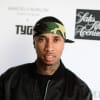

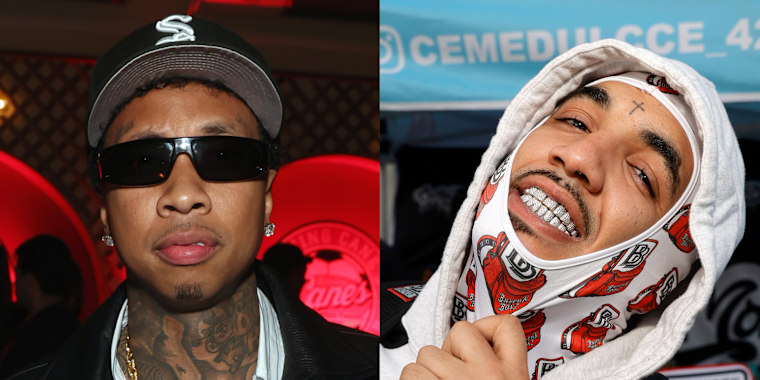
 Photos by Phillip Faraone/Getty Images for Raising Cane's Frazer Harrison/Getty Images
“If you like it, you like it, if you don’t, you don’t. I don’t care,” Tyga recently said in an interview with Vibe when asked about his usage of AI.
It’s no secret anymore that artists are taking steps into the new age of generative technology with their music. Most recently, rapper-producer Tyga confirmed that he used AI to produce his 80s-inspired album, $TARFACE, released on July 31.
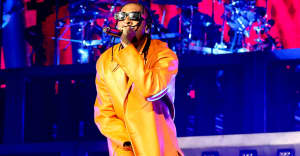
In the interview, the West Coast rapper said that AI shaped parts of the record's retro sound, including its synths and a guitar solo, while maintaining that he wrote the album and recorded all of its vocals himself. "We definitely used AI as a [tool]," Tyga said. He compared people’s disdain toward AI use with the skepticism of Auto-Tune in the 2000s, arguing that “real” artists adopt new technology rather than resist it.
Tyga is not the only rapper owning up to AI this month. On August 7, Fenix Flexin of Shoreline Mafia admitted that his viral hit "RUBBERZ" was made using the AI platform Treblo. After Flexin initially danced around the accusations on Instagram, Treblo released a tool that could determine whether a song was made using its software and subsequently showed that "RUBBERZ" was created "very likely" using Treblo. Flexin then went online to confess, "I didn't even know what da app was till we mixed it and erbody started commenting." The track peaked at No. 58 on Billboard’s Hot 100, being the first fully AI-generated song to reach the chart.
While these artists are reconciling their AI use with the public, Ye, who has doubled down with the use of AI, is facing legal action over his auto-generated vocals. An anonymous producer "John Doe" is suing Ye for $220,000 over uncompensated work across Vultures 2 and Bully, for which the producer allegedly created over 13 custom AI voice models, more than 400 vocal generations, and recorded his own voice for usage. Previously, Ye's team stated Bully would not feature AI at all.
The disclosures sharpen skepticism over whether AI-assisted songs belong on the charts and pose new problems for artists using the generative technology.