 Courtesy of Saucy Santana
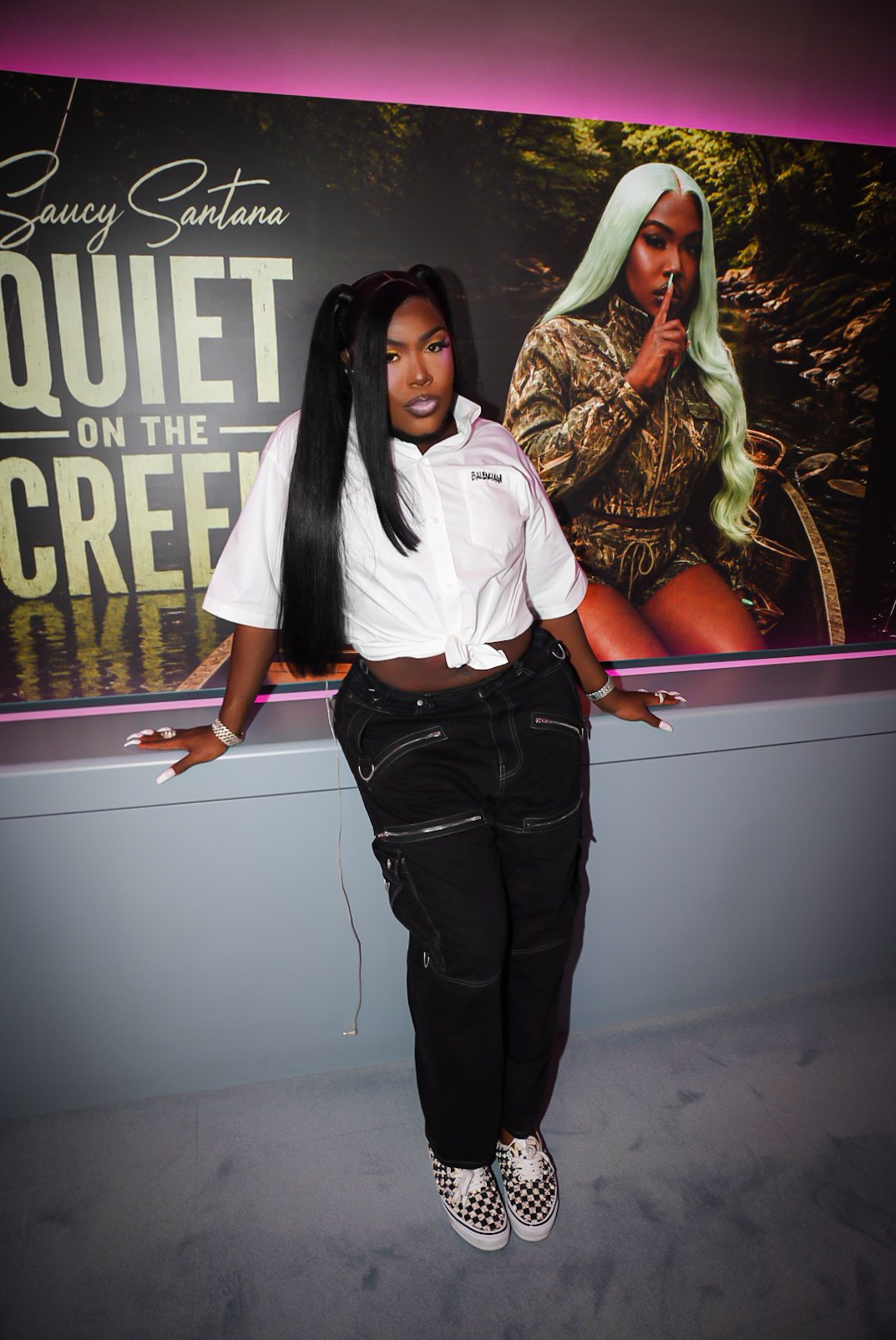
Saucy Santana didn’t intend on going viral again. His most recent stunt, coining the term “quiet on the creek,” stemmed from an Instagram livestream from two years ago, in which the Florida rapper and Yung Miami were chowing down on fish. “I was laughing about the head being on it,” he remembers. In the Live, while hovering over the platter, Santana recalls how he used to go fishing when he was "a little girl" and shares a tip for charting the waters: “You gotta be real quiet on the creek.”
It was an unfiltered moment between the two musicians, but the sound bite had other plans to live on. In early July, somebody reposted a clip from the livestream on TikTok where it spread like wildfire. By July 17, Santana had dropped “Quiet on the Creek” as a single and it quickly climbed the ranks. #QuietontheCreek is currently No. 1 on TikTok music and debuted at No. 45 on Billboard’s Hot R&B/Hip-Hop chart. Much of the song’s success was amplified by the accompanying trend of people shushing, tiptoeing, and bouncing to emulate the feeling of being “quiet on the creek.”
Read Next: Saucy Santana shares new song “Bop Bop”
It’s not the first time Santana, known for churning out catchy club tracks, has had a mundane moment turned into an internet sensation (See: “Material Girl” and “Walk Em Like a Dog.”) But even the bona fide meme-maker himself was taken aback by the engagement. “That was just me being me, clowning around with my homegirl.” Ahead, hear from Saucy Santana himself about making “Quiet on the Creek,” creating (and coping with) virality, and more.
The FADER: Obviously, “quiet on the creek” is literal, but the meaning has since evolved. In your opinion, what else does, or can, it refer to?
You can have your own interpretation. Say, you’re about to get a raise at your job. Sometimes, we don’t like to talk about our blessings — we like to wait until it actually happens to announce it. You’ll be quiet on the creek.
If you’re going to your favorite corner store by your house and you have your bonnet and nightgown on, you ain’t trying to see or run into nobody. I ain’t trying to be loud. I don’t want to take no pictures today. I’m trying to be real quiet on the creek.
When we were kids, we hung with our friends or went to parties, but sometimes you had to sneak out of the window. It was real quiet on the creek. [The phrase] could be literal, but it’s also whatever you want it to mean.
What have been your favorite interpretations of “quiet on the creek?”
Oh my god, there are so many TikToks with different scenarios. My favorite one was when somebody said that they turned their location off, and their friends were texting them like, “Girl, where are you? Who are you with? Why is your location off?” If your location is off and I can’t see where you at, you’re being real quiet on the creek!
I tend to have these influential and impactful moments, and I don’t know if sometimes I’m too quiet on the creek.
What made you decide to turn “quiet on the creek” into a song?
I wanted to use this momentum to make it into something, since people seemed to genuinely like the phrase. I’m so used to being viral. But I don’t plan on going viral. It just happens organically.
Initially, somebody found an old video of me. Whenever I was live streaming, everybody was in my comments like, “You got to be quiet on the creek.” I was like, “What’s going on?” Even when I was going live with other people, other people were like, “Hey, my chat is telling me to be quiet on the creek. Does anybody know what that means?”
It gets overwhelming being so viral all the time. But I literally had an epiphany in that moment because I tend to have these influential and impactful moments, and I don't know if sometimes I’m too quiet on the creek. I thought, “Alright, I gotta do something about it.”
I planned on doing a freestyle because in my head, I thought it was corny to make a song. Like, am I reaching? I don’t have to make a song. But I called [my producer] Tre Trax about the freestyle, and he suggested doing a song instead. He said, “It doesn’t hurt; if it works, it works; if it don’t, it don’t.”
I was still hesitant. I was at the house lying down. I was tired. I didn’t want to go to the studio to record the song. But for some reason, I couldn’t go to sleep [that night]. It felt like God was telling me to go to the studio. I went, and I actually live-streamed the whole process on TikTok.
[My viewers] watched me listen to the beat, write it, record it, do the ad-libs, and all. By the time I left the studio, my whole For You Page was me in the studio rapping and dancing as I made the song.
That’s when I knew we had something here. I called my label and suggested putting the song out on Friday. I wanted to capitalize on it because sometimes, when there’s a trend, people wait weeks or a month, but the world moves too fast. We put the official sound on TikTok. The official sound did over 200,000 creates on the first day. The song wasn’t even out yet.
 Courtesy of Saucy Santana
While recording, did you feel that the lyrics and ideas flowed to you easily?
It was so easy because I was genuinely having fun. I was with my chat, and it was flowing. It came together so perfectly because it was me. With “Quiet on the Creek,” I gave myself a topic. I said, “I’m gonna rap about a nice wealthy man with a coin, and he got a girlfriend. You been trying to get you a little something too, so you got to be real quiet on the creek.” I gave myself a scenario I’ve seen before, played around with it, and the [lyrics] flowed.
In your opinion, what ingredients make for a viral song in 2026? And what qualities do you think “Quiet on the Creek” has that made it a hit?
Authenticity. Sometimes, you listen to a viral song, and you try to go the route of virality when you need to do what works best for you instead. What’s for you is for you.
Nobody can bring what I bring to the table. It’s mine. It’s my energy, swag, the way I deliver the lyrics, the way I write the words, the wittiness, the flow, [and] the way I change up my voice. Do what works for you, and let that go viral versus chasing a viral moment or song.
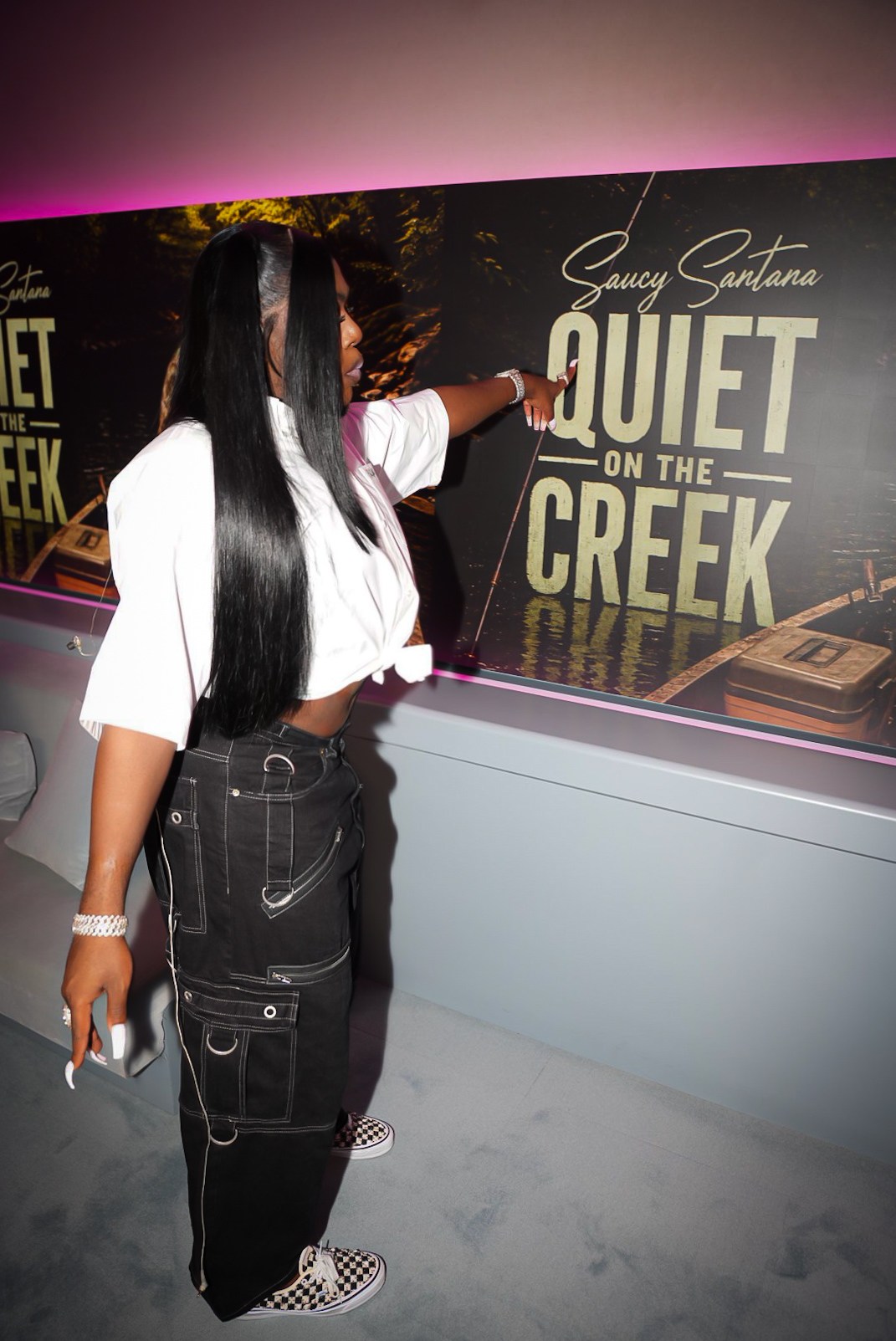
Many people expected the music video to be nature-inspired, but were surprised that it was school-themed. What made you decide to create Creek University?
Right before “Quiet on the Creek” came out, Lizzo hit me up, and she wanted to sneak me into [Kai Cenat’s] Streamer University because she wanted me to perform “Quiet on the Creek” in the classroom.
I’m so used to being viral. But I don’t plan on going viral.
When I flew out [to Arkansas], I was trying to be quiet on the creek at the airport, but people saw me and started taking pictures, and it went a little viral. The next day, I met up with Lizzo on the road from the school. I hopped in the car with her, and we had to sneak the car onto campus. She was distracting the security guards. It was so fun because it reminded me of being a kid when I used to sneak onto college campuses and stuff. By the time I got into school, I thought we were good, but security came and found us. When I went back to my hotel, I was like, damn, we were too loud on the creek.
But I thought that moment was a perfect example of being quiet on the creek. It went so viral, and I want to redo this situation in my music video.
There must be pressure to create constantly and keep up with the fame, virality, and relevance. How do you manage external expectations? Also, how do you balance commercial demand versus creating for yourself?
I keep myself busy. Even when I had a time when my music and stuff were slow, I went into live streaming [on TikTok]. I built a fan base, more of a community over there, and actually, in return, it helped with my music. So, I don’t stress myself out about what’s next. I’ve learned that when I have fun and do me, it works.
With “Quiet on the Creek,” I was in the studio having fun. I wasn’t overthinking my lyrics. I wasn't trying to have the most lyrical cipher. Somehow, it’s already one of my biggest songs. I never had a release that big, especially the first-day numbers. Never. And I wrote [“Quiet on the Creek”] in 45 minutes.
 Courtesy of Saucy Santana
Being in the public eye means being perceived by the internet in ways you can't always control. Recently, there’s a video circulating from your livestream of you in a pool. It has since gotten a polarizing reception from your audience. Do you have a response to this video?
It’s only so much that you can do, so I hold myself accountable. Any time people find things about me that could be misinterpreted, it's always old. That video is from 2021, maybe. It’s already been addressed.
I learned that I have to be more responsible with my words. I’ve grown as an artist, a person, and a celebrity. I take the punches and show up every day. It doesn’t define me as a person, and this is all a part of the process. I know better now. I watch what I tweet. I watch what I say on a livestream. I’m cautious.
How do you cope with these situations?
I show up every day as myself. Whenever I’m viral or have a huge song, people like to dig up old clips or old [posts] and try to find something to tear me down.
I’ve learned I’m way more of a star than what I was back then. I have to be careful with my words because it could be perceived the wrong way. But I’m also not into beating people's brains about what they want to believe, whether the truth is in their face or not. People like to feel like they got you by the balls or they got your career in their hands, and if they want to cancel you, that’s what they’ll do.
I’m also very in tune with real life. I was in New York a couple of days ago, and I went out into Times Square with my team. Every two minutes, I was being stopped by people. Everybody wanted to do “Quiet on the Creek” TikToks with me and everybody wanted photos with me. I’m on a club tour right now, and the whole club is packed. The love in real life, the impact and influence I have in real life, is way different. The people who get it, get it.
This interview has been edited and condensed for clarity.