Courtesy of HYBE/Republic
When Rhea Raj calls in from her home in Los Angeles, a week has passed since the news officially dropped that the nascent popstar inked a joint venture with HYBE America, Republic Records, and 5 Junction Management. The deal — which bears resemblance to the HYBE x Geffen contract that formed her younger sister Lara’s multinational girl group KATSEYE — has been a long time coming, she says.
“I think about the timeline of my life so much,” she adds. “Where I’m at right now feels like all the stars have aligned themselves in a way that I always hoped they would. I couldn’t have been better poised for it than I am right now.”
Even though many have discovered Raj in the past few years, the singer has been pursuing superstardom for a decade. Her first parlay with the spotlight was as a contestant on season 15 of American Idol in 2016. In the last few years she has bubbled up on her own through two album releases and a slew of confident and slinky capital-P pop singles like 2022's "Devil In A Dress." But only now, she says, does she feel like she has the tools to finally be able to build the full extent of her dreams. “For the first time in my life, I’m creating music and visuals of my next project from the most genuine, innocent, childlike space I’ve ever been in before,” she says.
Ahead, The FADER talks with Rhea Raj about signing to HYBE and Republic, South Asian representation in pop, addressing her critics, and more.
The FADER: Congratulations on the news. How did this opportunity come about? What ultimately made you decide to sign with HYBE and Republic Records?
Rhea Raj: Backtracking a few years, I signed my first publishing deal with J. Kash, who’s an incredible songwriter. It brought me from New York to L.A. five years ago. I was writing and producing a lot for myself and other artists, and I grew my network in L.A.
I always wanted to focus on my projects and release my own music. I met with my manager, [5 Junction Management’s] Anjula Acharia, exactly a year ago today. We initially met while I was on American Idol in 2016. I asked my mom to send her an email. She was my dream manager — she’s Priyanka Chopra’s manager, who, for a lot of us brown girls, is our it-girl icon who came from India and did her thing in the U.S.
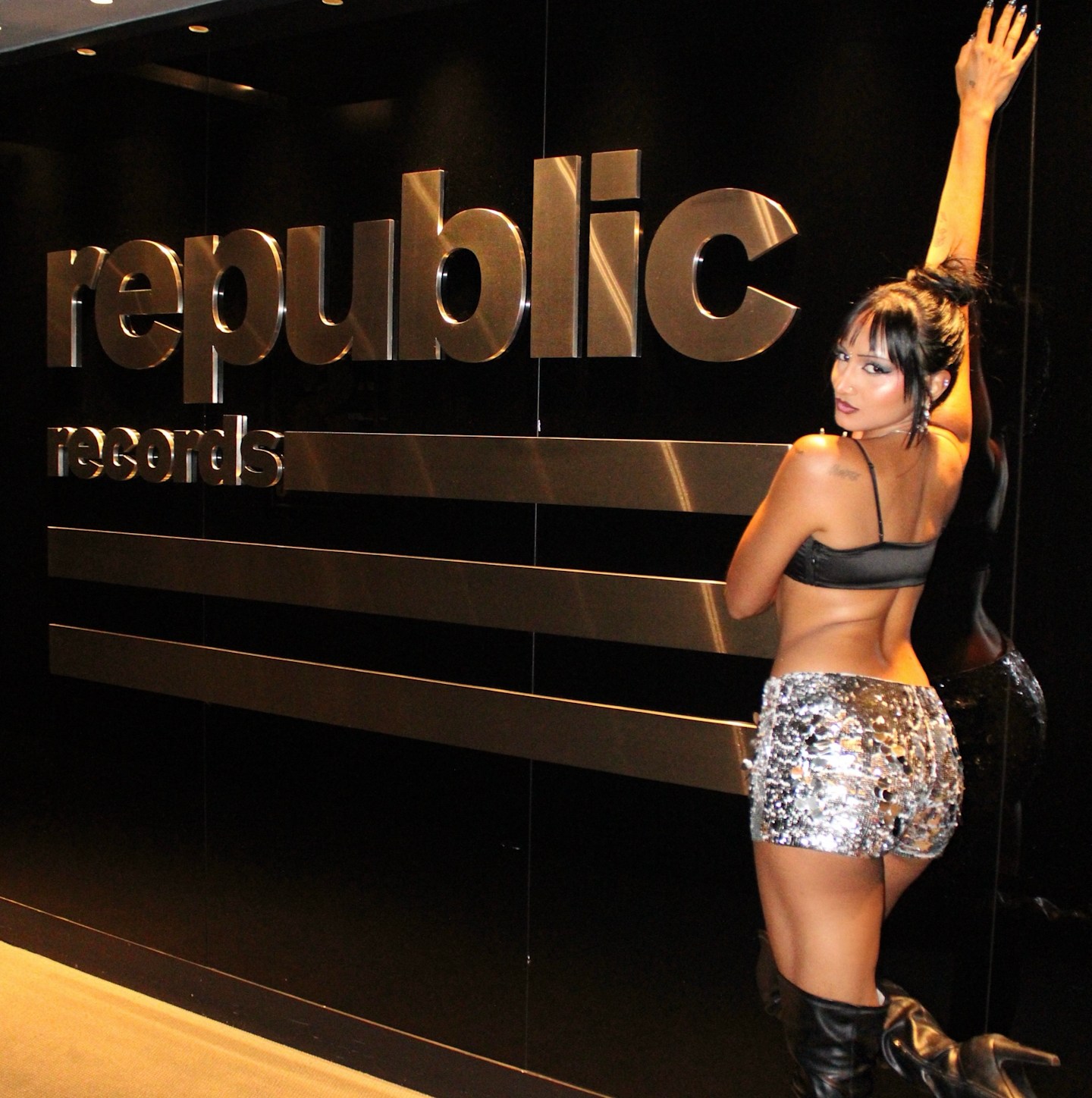
Fast forward exactly 10 years later, we connected, and she saw my vision and understood what I wanted to do as an artist. We started working together over the past year. I told her my goal was to sign with Republic because it was always a dream label. She set up dinner with Republic Records founder Monte Lipman and HYBE America’s CEO Isaac Lee. It was all [kismet]. I feel like I have the Avengers as my team. I’m excited for this new chapter with all these incredible people supporting me.
How different is this compared to your life as an independent artist?
My team laughs about this every day because the one thing that will never change about me is how on top of everything I am when it comes to the creative process. I’m still coming up with music video concepts, brand decks, and moodboards. People don’t realize that over the last several years, I was the one editing and designing my website. I was uploading every single release. The administrative stuff behind that is so unsexy. I can finally focus on being an artist, elevate my work, and create even cooler music and visuals.
 Courtesy of HYPE/Republic
What are your thoughts on the current state of South Asian representation in pop music and globally? What are you hoping to achieve now that you’ve inked a contract that focuses on expanding representation across the board?
I’m Indian-American. I was born here in the U.S. to immigrants. I always grew up with a deep love for my roots. My mom ran a Bharatanatyam school, so I did classical Indian dance. I’d come home every day and train, and I was so proud of that side of my identity.
My parents also took me to concerts. I was watching Hannah Montana, and I loved Britney Spears, Rihanna, and all the pop girls. They’re both important sides of my identity, and I’ve always wanted to make them become one.
Growing up, I didn’t see people from India or South Asian artists on big stages. It would’ve made me feel a lot cooler and prouder of myself. I hope that by signing with a big label, I can reach more people and versions of little Rhea. I want them to see all the things that I’ll do over the course of my life as an artist and think, “I can do this too.”
Overall, it’s an exciting time [for South Asian creatives]. We’re seeing a rise of creatives across industries in the fashion space — South Asian designers are blowing up, and their work is being recognized globally. It’s also happening in music and film. I’m excited for our people.
Your sister, Lara, is signed under HYBE. What was her reaction to you signing to the same label?
We’re both super proud and excited for each other. We want each other to have great teams around us and to be able to grow and expand our visions. It’s such a blessing that we get to be on this journey together as artists and as sisters. There’s lots of excitement in the Raj Fam house right now.
 Courtesy of HYBE/Republic
It’s so crazy to me that when you see women in general, but especially a woman of color, breaking boundaries, people always want to find a way to undermine how someone got there.
I saw the feedback online, with some people accusing your deal with HYBE of being due to nepotism, among other criticisms against the label. What are your thoughts on the negative feedback? How are you dealing with it?
I genuinely don’t look at the internet that much. I’m focused on creating my art and protecting the energy around that. I put out a video on my YouTube channel that was a showpiece for new fans and for people who have been part of my journey for the last decade. It talks about my life story and how I got here. I hope people watch that and get more of a peek into my journey as an artist and the grind that led me here.
It’s so crazy to me that when you see women in general, but especially a woman of color, breaking boundaries, people always want to find a way to undermine how someone got there.
Can we expect to see a collaboration from you and Lara as a sister duo in the future?
That’s something we’re definitely going to do at some point. For now, she’s doing her thing right now, and I’m going to do my thing. We’ve always written and produced stuff together. We have ideas of what we would want to do. She’s my bestie.
 Courtesy of HYBE/Republic
Earlier, you mentioned being the best version of yourself right now. But were there ever moments in your career where you felt like you hit rock bottom? If so, how did you overcome it?
During American Idol, I was 15. When you’re 15, you don’t think about anything past that age. I thought the opportunity would change my life. Then, I got the flu and was eliminated during Hollywood Week. I remember being so down about it for months. I thought it was the beginning of the end. But from a young age, I learned that rejection is redirection, and how to navigate and pivot in those moments.
Last summer, I was about to drop my project, COMMOTION, but I was going through the worst rock bottom in my personal life. As an artist, everything bleeds into each other. I was at a place where I didn’t know what the future had in store for me. After I released the project, the response I received gave me so much hope. Something switched in my brain, and I was like, “Well, we can only go up from here.” I’m going to use all of the fear, sadness, and pain and continue turning them into art. That’s the beauty of life. That’s my mission statement as an artist: turn the tears into beautiful music.
This interview has been edited and condensed for clarity.