What we’re missing from the Zelda: Ocarina of Time remake soundtrack
Re-iterations of Koji Kondo’s classic score refuse to strike out on their own, but can’t quite live up to the legacy of their predecessors either.


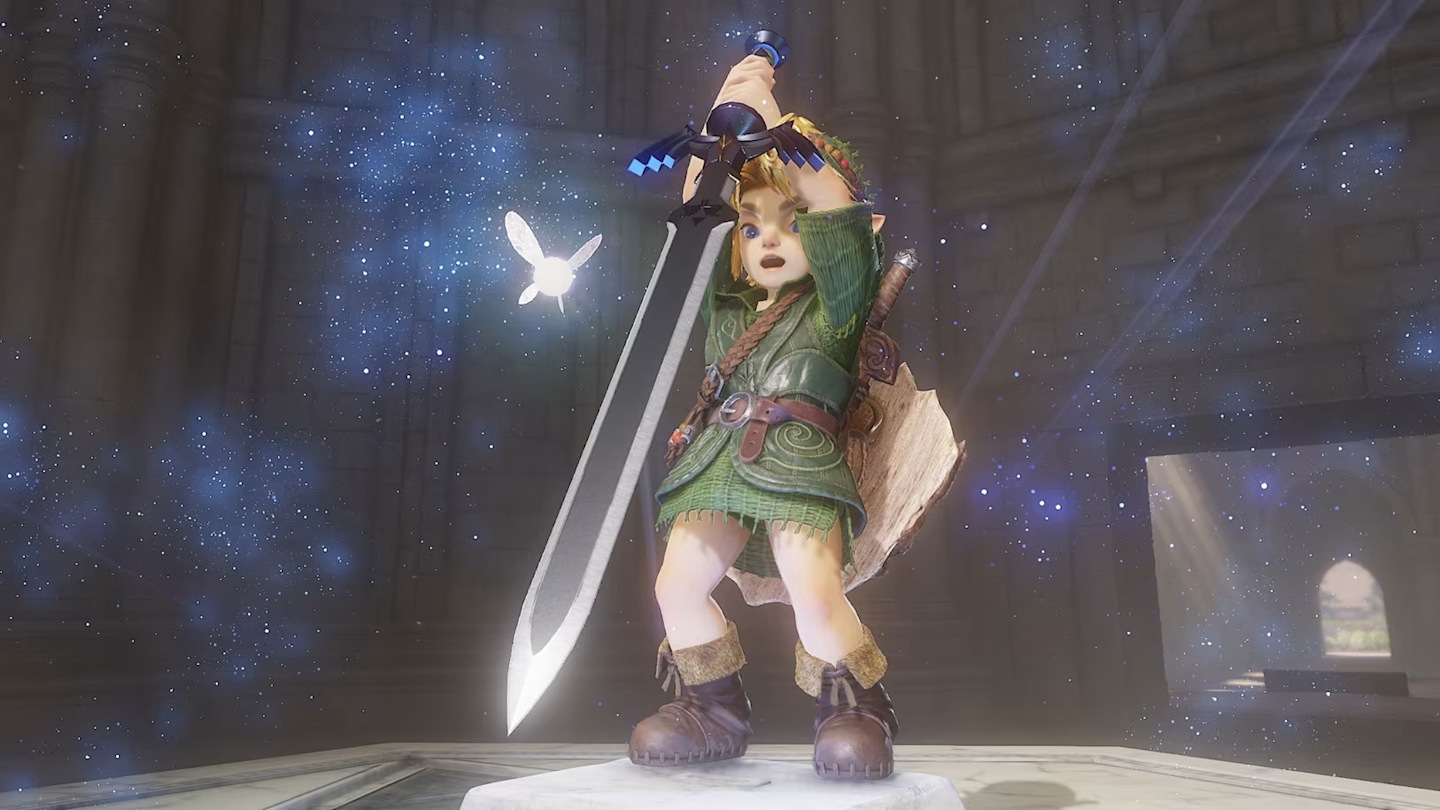 Young Link in the 2026 remake of The Legend of Zelda: Ocarina of Time for the Nintendo Switch 2.
Nintendo
It was inevitable that Nintendo’s unwavering obsession with nostalgia would lead to a new remake of 1998’s Ocarina of Time for the Nintendo Switch 2. The first 3D entry in The Legend of Zelda series is a longstanding candidate for the greatest videogame of all time, a coming-of-age tale that riffs and ruminates on the idea of time itself. It’s the archetypical 3D adventure game: delicately balancing sparsely rendered atmospheres and graphical ambition, Ocarina popularized now-commonplace features in the genre and set a cinematic benchmark for all Nintendo games to follow. Countless ports later, including a ground-up remake on the 3DS in 2011, a 2026 edition of Ocarina makes a phenomenal bridge between eras of 3D gaming.
For all that might’ve aged about the Nintendo 64 original, its soundtrack remains the game’s most enduring element. Koji Kondo’s original score was crystallized by hardware-limited instrumentation, jammed into the small memory capacity of the N64. As a result, his global palette of ROMpler and sample CD sounds carry a difficult-to-replicate allure, soaked in grain and compression. Amputated as they were, Kondo parlayed these restricted samples into sparkling ambiance, harrowing chaos, and the heartfelt fantasy of pure adventure. They accompany graphically liminal environments, yet fully encapsulate the lucent imagination at the heart of the game’s innocence-to-adulthood quest. It’s a perfect score made possible by its imperfections – bound by time and space, timeless and transcendental because of it.
Ocarina’s 2026 remake is acutely aware of how timeless its source material has become. This reverence seems to have stymied the imagination of sound director Masato Ohashi and co.: the remake’s new score is little more than a souped-up palette swap of its predecessor. It holds a mirror to the original’s perfection with its structural arrangements, but staring back is a shell of its former self, lacking the intricacies of Kondo’s N64 composition process. Instead of rebuilding Ocarina’s musical essence from the ground up – an effort befitting of its legacy – we’re left with little else than cloying nostalgia and live orchestrations of dubious added value.
With more memory, more resources, and a wider audience than ever, Ohashi’s team had plenty of reason to steer Kondo’s original ambition into a new, modernized direction for the Switch 2 edition. But nearly every song here is played frustratingly safe. Tracks like “Song of Storms” and the iconic “Title Theme” sound ‘new’ thanks to enhanced instrumentation, but their faithful reiteration of the originals leaves them feeling like flat facsimiles. Meanwhile “Hyrule Field,” a lengthy song that begs for novel twists and turns to enter the fray, trudges on and on with the same diegetic progressions as before. The rare moments where songs receive even slightly altered arrangements, as with the added string swells on “Great Fairy’s Fountain,” are a genuine shock.
Instead of original compositions, we get the 2026 soundtrack’s signature admixture of new and old soundkits. The soundtrack features a confluence of live orchestra recordings and “resourced” sounds from the N64 original (ostensibly just uncompressed presets and audio files from Kondo’s ROMpler and sample CD libraries). Plenty of videogame scores have utilized this anachronistic tension to great, even outstanding results. That tried-and-true direction fails for Ocarina because Kondo’s old sounds re-emerge in mostly unchanged arrangements; instead, they feel like shallow nostalgic novelties.
The stinging decrescendos of 1998’s “Water Temple” are hastily shoved into the remake’s intro, then jarringly reinserted at the song’s midpoint in a nauseating concoction. The frantic pianos of the “Boss Battle” theme sound distractingly lo-fi, as if they were sampled from the original theme via YouTube to MP3 conversion; the “Middle Boss Battle” theme, on the other hand, softly inserts ROMpler horns from the original for no substantive reason. The reintegrated sounds rarely, if ever, serve a greater purpose in the game beyond these types of hackneyed “remember that” moments.
These lapses seem to indicate a critical flaw in Ohashi’s desire to “preserve [the] simplicity” of Kondo’s masterwork: Kondo’s original score was never simple. So it’s disorienting to hear his old sounds return without any of the carefully tempered luster he achieved through his brilliant experimentations with effect bays and sampling. The updated “Forest Temple” theme features all of the original’s instruments in the same exact structure as before, yet sound marginally worse without Kondo’s compositional complexities. The song’s signature lead riff loses its eeriely coarse texture, its flute stings and yelps sit boringly low in the mix, and formerly dense pads feel thin as air. The original “Zora’s Domain” gained its shimmering allure from Kondo’s expert use of reverb, which collided steel drum leads and glistening pads into a calmingly crowded percussive arrangement. The new version is chilled out to a fault, ditching the original’s harmonious interplay for two reverb-free string riffs layered on top of each other. Kondo’s Ocarina does so much with so little; nearly 30 years later, how can its latest iteration do so little with so much more?
The new soundtrack does occasionally meet the moment to widen the game’s scope, particularly the original tracks for the remake’s brand new cutscenes. As Impa and Sheik tease towards the coming Shadow Temple in a talk over the Kakariko Village well, a properly macabre tune sets the scene, complete with suspenseful choirs and sinister strings reminiscent of, but not aped from, the haunted level’s music. And the introduction to Ganon’s Castle – previously dead silent – gets a brooding ambient track that pairs nicely with the added voice acting.
These cutscenes succeed because everything about them feels new, including their music, but that newness remains spiritually tethered to the original Ocarina’s essence. Beyond its slightly tweaked presentation and gameplay, nothing about the remake is especially different from the original. This fear of deviation similarly plagued the 2011 3DS remake of Ocarina fifteen years ago, but that edition was released on a secondary handheld console as a sort of retro novelty – its sound team even worked at length to recreate Kondo’s original score as closely as possible. The current sound team is evidently just as hesitant to lose the original’s spirit by significantly altering its music. They do a little more than the 3DS team by integrating truly modern instrumentation, but they fail to realize how the original’s spirit might be magnified by embracing the new.
It’s something that should be familiar to Nintendo; they’ve only been re-orchestrating, rearranging and remixing Ocarina’s tracks for decades now. “Gerudo Valley”’s fiery flamenco was rekindled in 2018’s Smash Ultimate – its core components rewired into a familiar but fresh arrangement. Its remake versions are clean and bland – caught between modern unoriginality and the absence of its predecessor’s archaic charm. “Lost Woods” got the half-synthetic/half-orchestral treatment in 2001; “Zora’s Domain” already verged into sparseness in 2006. We’ve heard it all before. Nearly everything the remake gives us is either disparagingly by-the-books or markedly less rousing than the restrictive beauty of Kondo’s N64 compositions.
Ironically, what we have here isn’t stagnation, but regression. Ocarina is a game deeply concerned with the passage of time, built as it is on the idea that the past can be powerful and essential, but never a substitute for the present itself. As Link grows up, he’s forced to leave the past behind (his childhood, his loved ones, his innocence), though the spirit of what he’s lost empowers him to prosper in a better future. As in real life, retreating into the past means losing the capacity to strive forward in the present. The soundtrack for the Ocarina of Time remake shies away from the game’s own core virtues, stuck in a past it no longer needs to rely on.
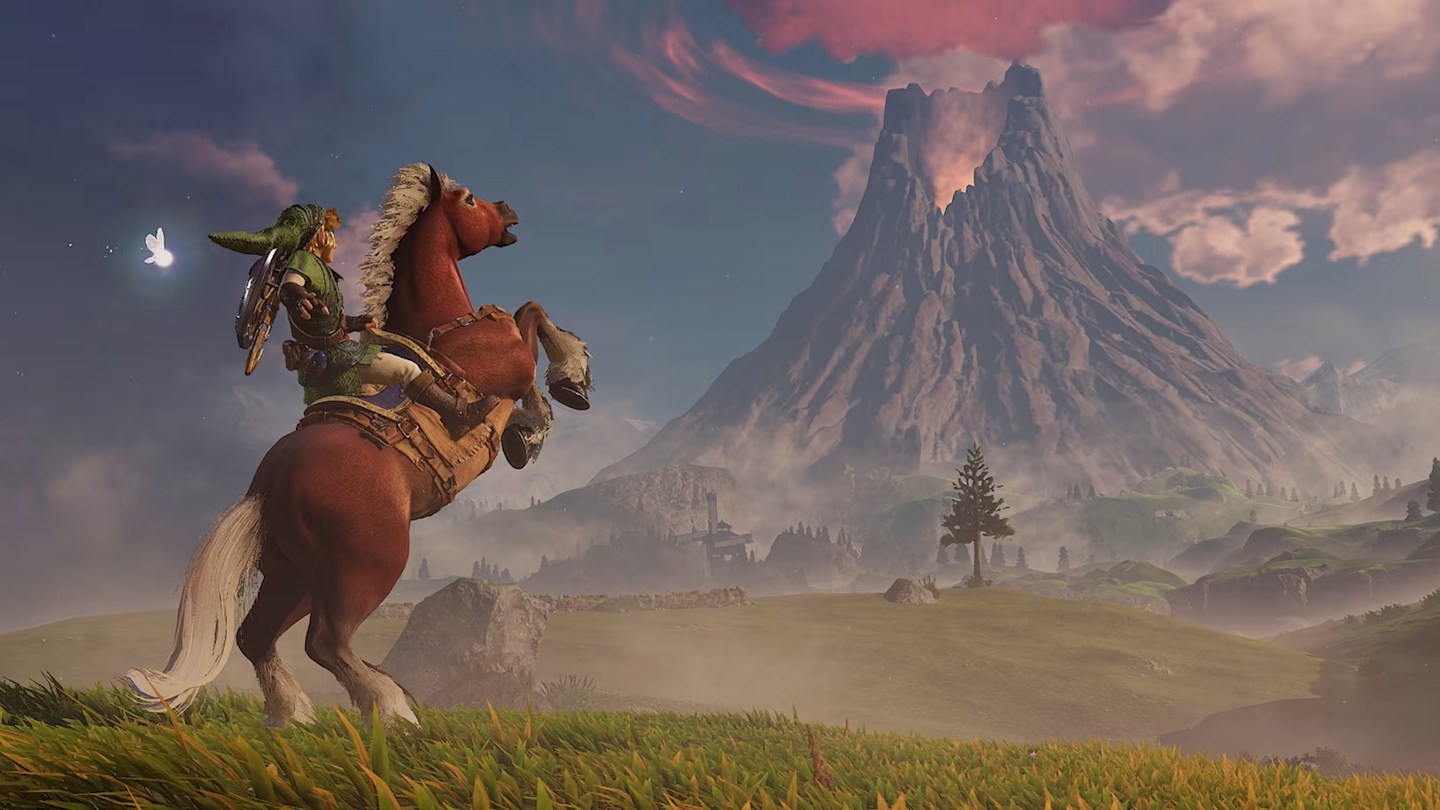 Link on horseback in the 2026 remake of The Legend of Zelda: Ocarina of Time for the Nintendo Switch 2.
Nintendo