


Rochelle Jordan can pinpoint the exact moment she first started hearing music. She was in grade three, and one day during music class, Jordan’s teacher divided everyone into three groups to sing “Twinkle Twinkle Little Star.”
“I was in group three, so group one started singing it, and then group two came in singing the song, harmonizing,” Jordan tells me on a Thursday evening at the Hotel Bel-Air, just before the day’s gilded light mellowed into twilight. “And then when we came in singing it, there was a three-part harmony – and a shift, some kind of brain chemistry happened in my mind. I was now awake to the sound of music, and to this spiritual experience that was happening for me specifically.”
A star was born, though she (along with everyone else) had yet to realize it. Case in point: there are no photographs or recordings of Jordan performing at various talent shows growing up, an oversight her mother laments to this day, often telling Jordan apologetically, I didn’t realize what you were going to become!
To be fair, sometimes it takes time for stars to grow bigger, shine brighter, appear as close to us as they are. And sometimes it takes a different perspective to see what has always been in view.
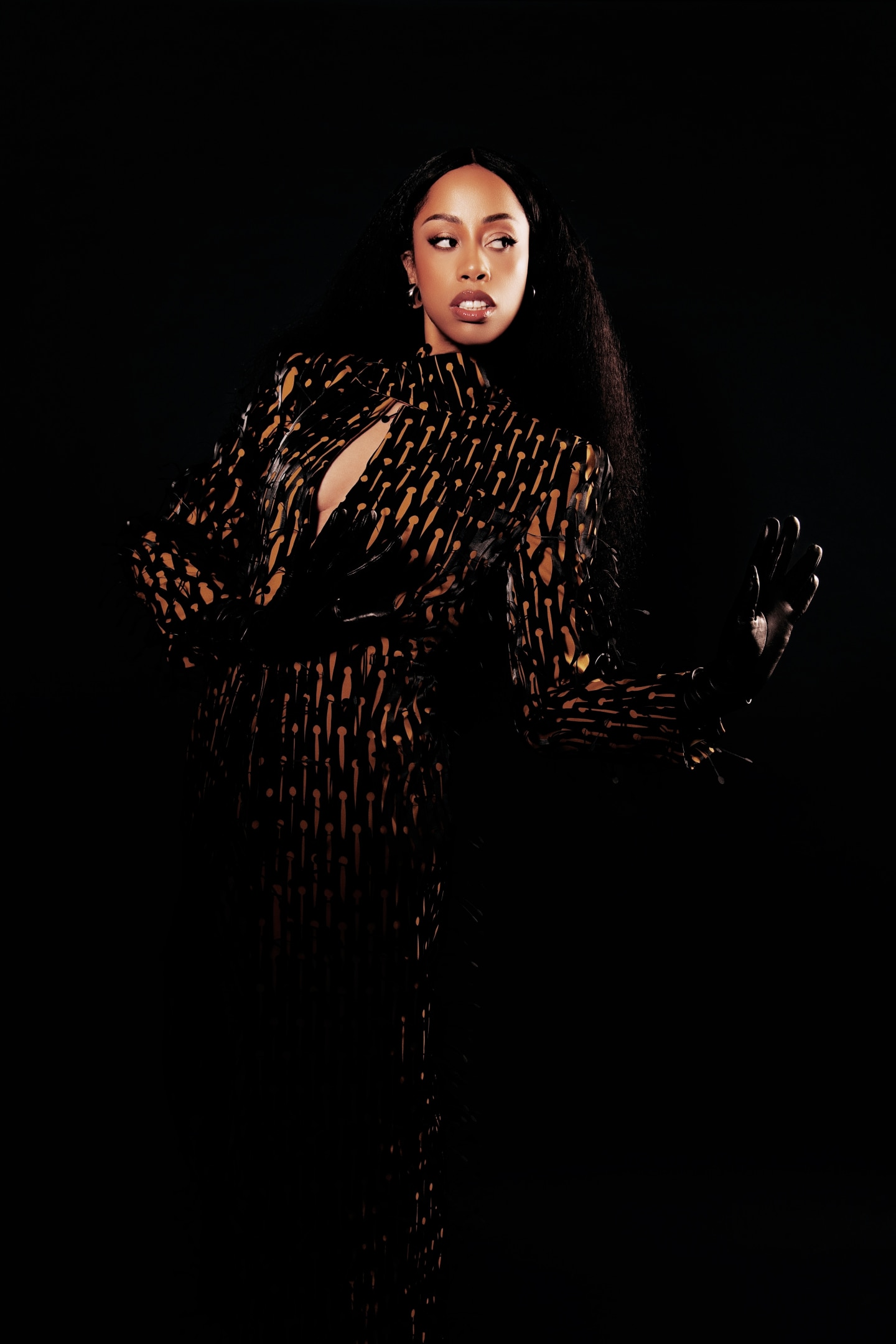 LUAR suit, WING+WEFT gloves, MISHO jewelry
We’re sitting in a leather booth at the hotel’s bar and lounge, and on the wall opposite us is a series of six images making up a single composition stretching 12 feet long and 5 feet high – impossible to miss. The photographs make up Bel Air Sequence, Tina Turner, Los Angeles, CA (1983) by photographer Norman Seeff (known for his iconic “sessions”) and show the late singer moving improvisationally with her classic rock 'n roll verve, somehow projecting a range of emotions across six shots that encapsulate different modes of the human experience. Shock! Desire! Joy! Angst! Surrender! Relief!
We’re so mesmerized by the images that they distract us momentarily from what we’re here to do, which is to talk about her latest album Through the Wall, released last November. But can you blame us? We are struck by the symbolism of Turner’s presence and expression, which feels like an affirmation that we are meant to be in this room (a room filled with entertainment business-types that Jordan has never been in before, one of many subtle signs throughout the day that reveal how uninterested she is with playing the game) talking about the history of Black women in pop and dance music.
Initially, we gazed at the images from afar, our phones face-down resting on the table, while we worked through some food: a mocktail and slice of apple crumble dessert for Jordan (who was craving something sweet even though it was dinnertime), and a lychee martini with a burger and fries for me. I had thought about taking a picture of the wall, but there were too many heads and tables in the way. So you can imagine how chuffed I was when later on, as we were walking out, Jordan turned around while pulling her iPhone out of a jumbo-sized, metallic silver Telfar tote, and snapped a few pictures of the artwork. “I had to,” she smiled.
In a poetic twist, Seeff took these dynamic images of Turner just before her major solo comeback in 1984 with the album Private Dancer. The parallels are not lost on me; though Jordan is not experiencing a career comeback, she is in the midst of a turning point, one that is slowly and surely moving her out of the occasionally frustrating territory of a gatekept secret into a lane of greater visibility with a larger audience.
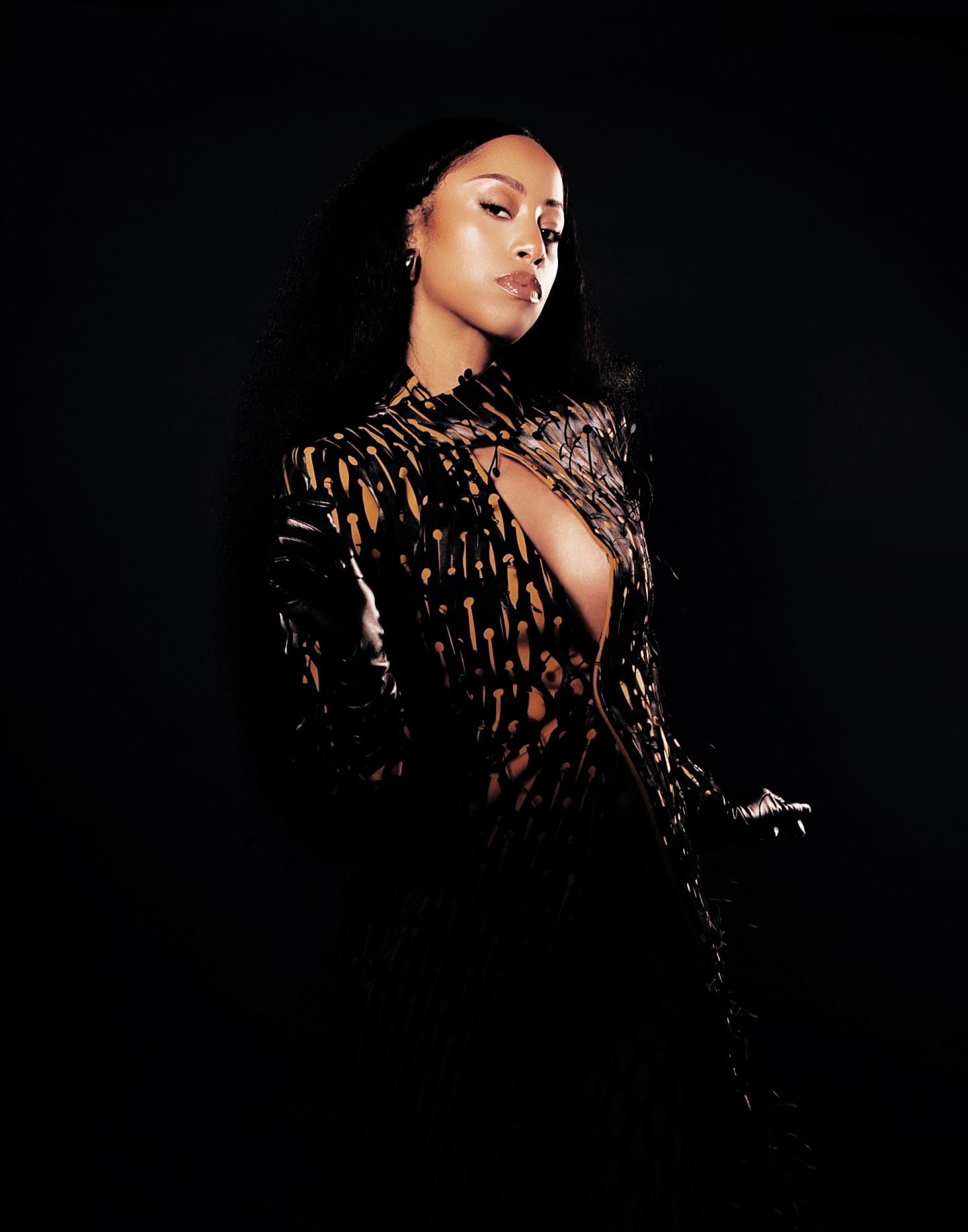 LUAR suit, WING+WEFT gloves, MISHO jewelry
Jordan is the youngest child of her British-Jamaican parents and was born in 1989 in High Wycombe, a market town in Buckinghamshire, England. Her family, which includes two older brothers, seven and 10 years her senior, moved to Wheatley, Canada, a suburb outside of Toronto, when she was four. Her childhood was comfortable despite the reality of being one of very few Black children in the predominantly white town (though there wasn’t a lot of “heightened racism that was obvious,” she notes), and interruptions to her daily life caused by frequent visits to the hospital to treat her sickle cell anemia, which she was diagnosed with at two years old.
“I almost died at that age. I had a lot of close calls growing up… and was falling behind in school,” Jordan says. “I could see that I wasn't living quite the normal childhood, but I was a very creative child. I was always painting or braiding my dolls’ hair and making them clothes and writing and creating songs even before I knew what songwriting was. I had the spirit of a creator.”
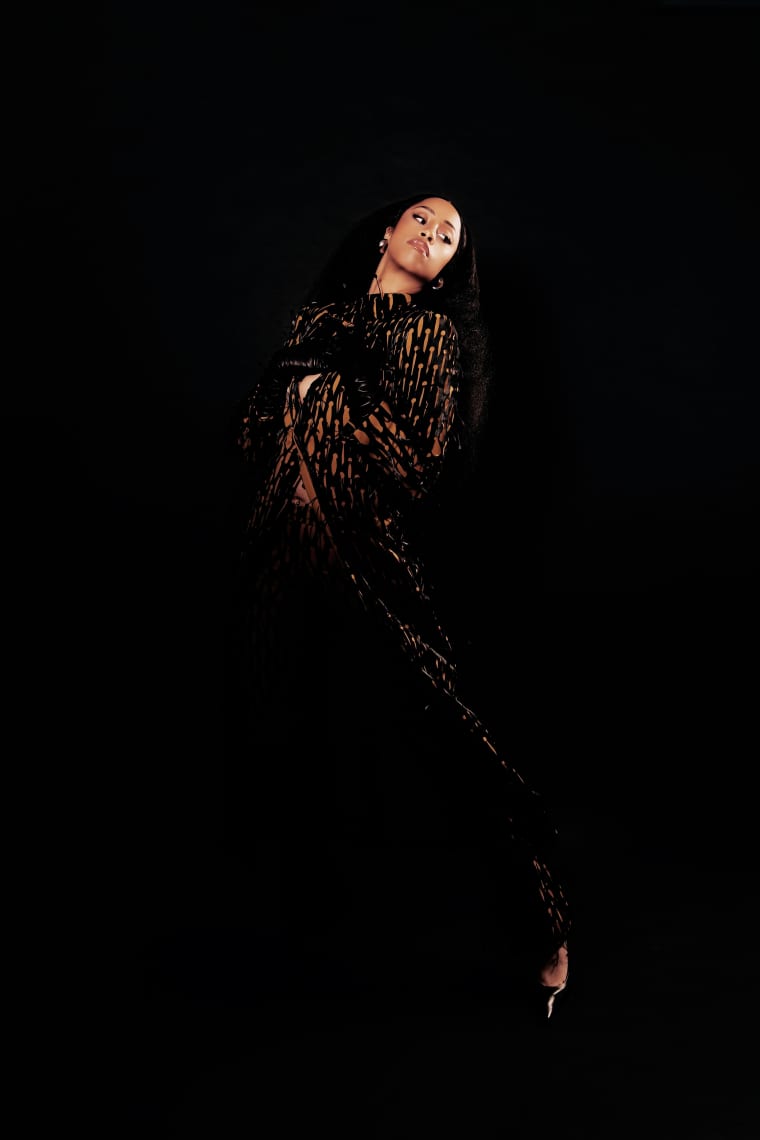 LUAR suit, WING+WEFT gloves, MISHO jewelry
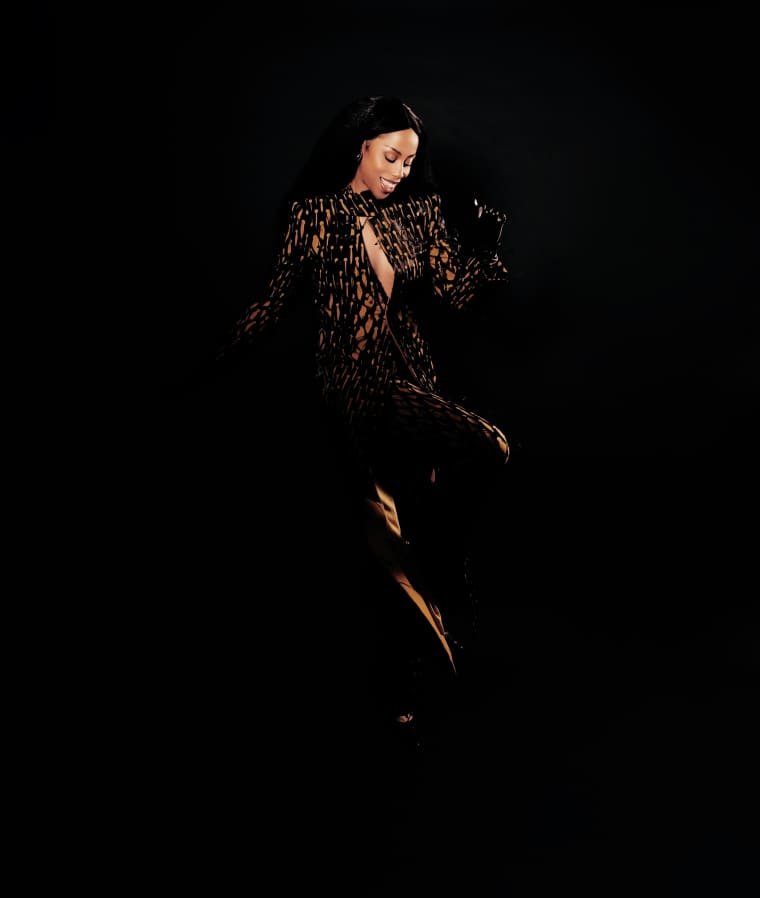
Music always had a strong presence in the family household: Jordan’s father is a musician, and her brother Junior, who has autism, was “the one who was very obsessed with music,” Jordan says, her eyes getting wide with emphasis. “That [fixation] turned into such a beautiful manifestation of growing up with music that’s out of this world – like, the deepest cuts.” Junior’s taste, and penchant for replaying his favorite tracks on a loop, exposed Jordan to a sonically rich and diverse mix of genres, including gospel, house, drum and bass, and jungle. He would play music so loudly Jordan had no choice but to pay the sounds she was hearing through the wall (a lovely example of foreshadowing) a significant amount of attention. Her immigrant story of moving to Toronto, and adapting to different customs and locales also shaped her ear. “I'm such a melting pot because of all these different experiences, these different sounds, foods, and cultures,” Jordan says. “It creates so much dimension in a person.”
Jordan first determined that she was going to start making music at 16; she wanted to find a producer in Toronto who was experimental enough for her style, and “understood the musical language that I wanted to convey to the listener and to myself.” This was around the time Drake and the OVO camp was putting a particular Toronto sound on the map, and all of the producers in her area were trying to emulate it to strike gold. “I knew that was not for me. I wanted something that was jarring and shape shifting, and I wanted a fearless producer.”
That’s when KLSH stepped into her life after discovering Jordan on YouTube. She’d uploaded covers of herself singing popular R&B songs by artists like Kelis, inspired by fellow Canadian Justin Bieber who’d gotten discovered this way. One day, she received 10 consecutive DMs from the Virginia Beach-born, Los Angeles-based producer, saying, “I don’t know if you’re signed but I think we would make really great music together,” she remembers. She went to his page, clicked on a beat affectionately called “The Neptunes,” and was instantly sold. “It was experimental and so much fun, dipped in so much sauce. It was the perfect mixture to create the world that we wanted to create,” she says.
Over a Zoom call, KLSH, who has served as executive producer and creative director for all of her projects, says he saw her potential immediately when they met in 2009. “She came with [British house music] already built in,” he said. “What people see now, I saw that, even when she didn’t necessarily see it herself. I consider myself a futurist kind of a person. I like to think about things ahead…Rochelle is always a person who’s open to new ideas.”
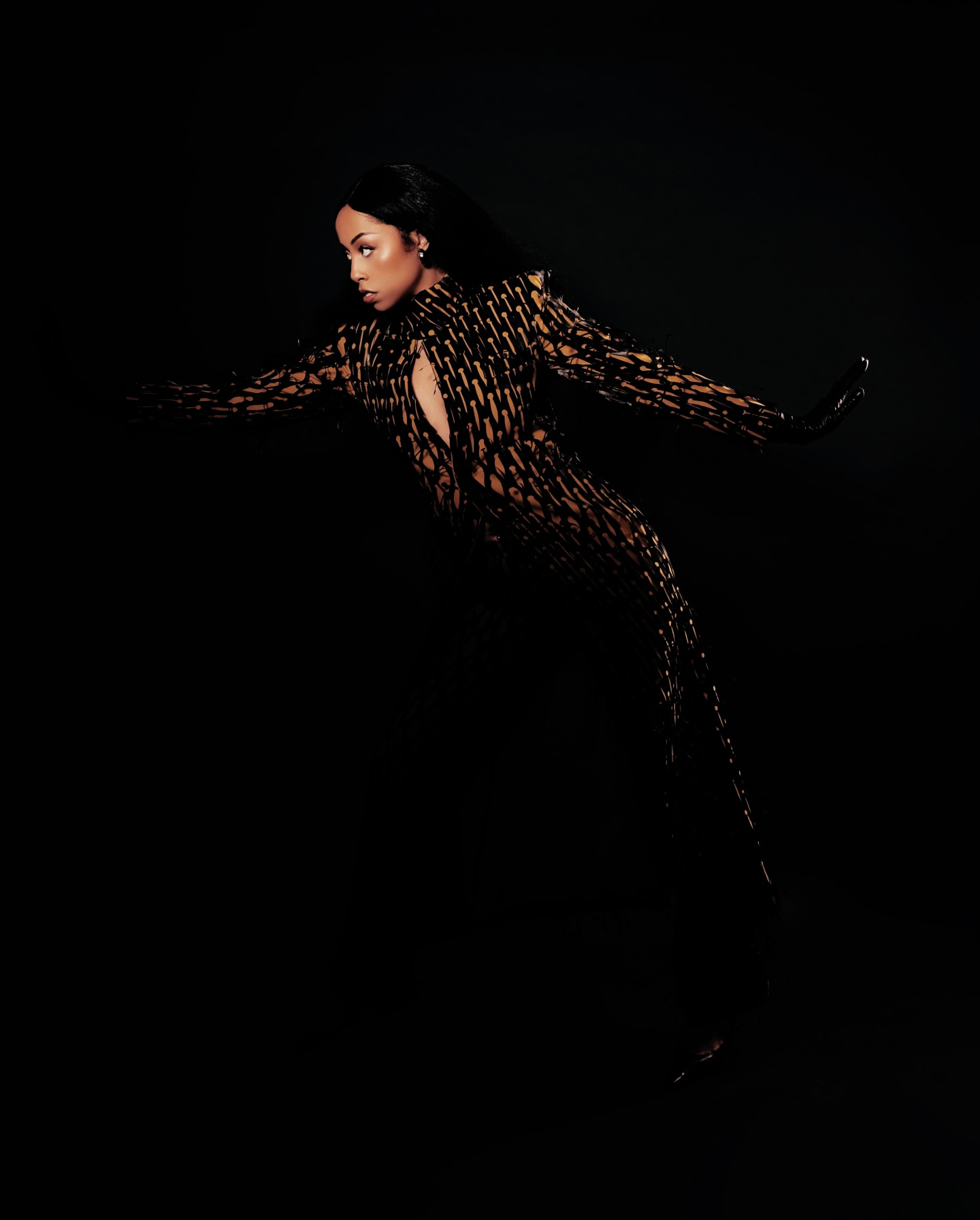 LUAR suit, WING+WEFT gloves, MISHO jewelry
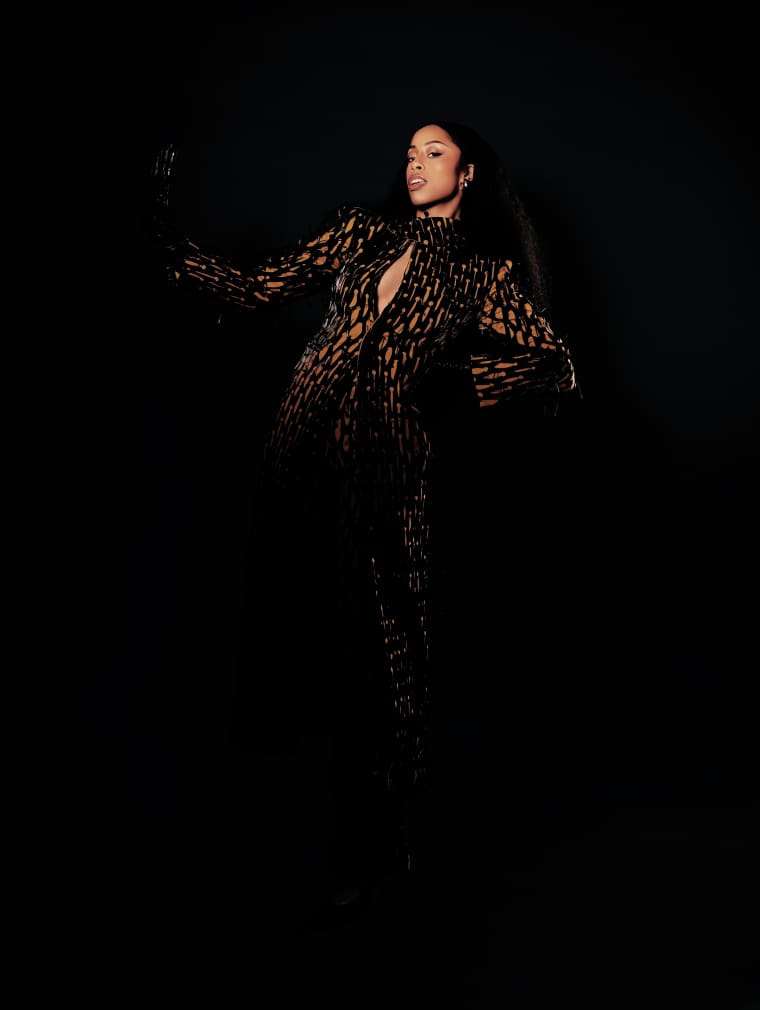 LUAR suit, WING+WEFT gloves, MISHO jewelry
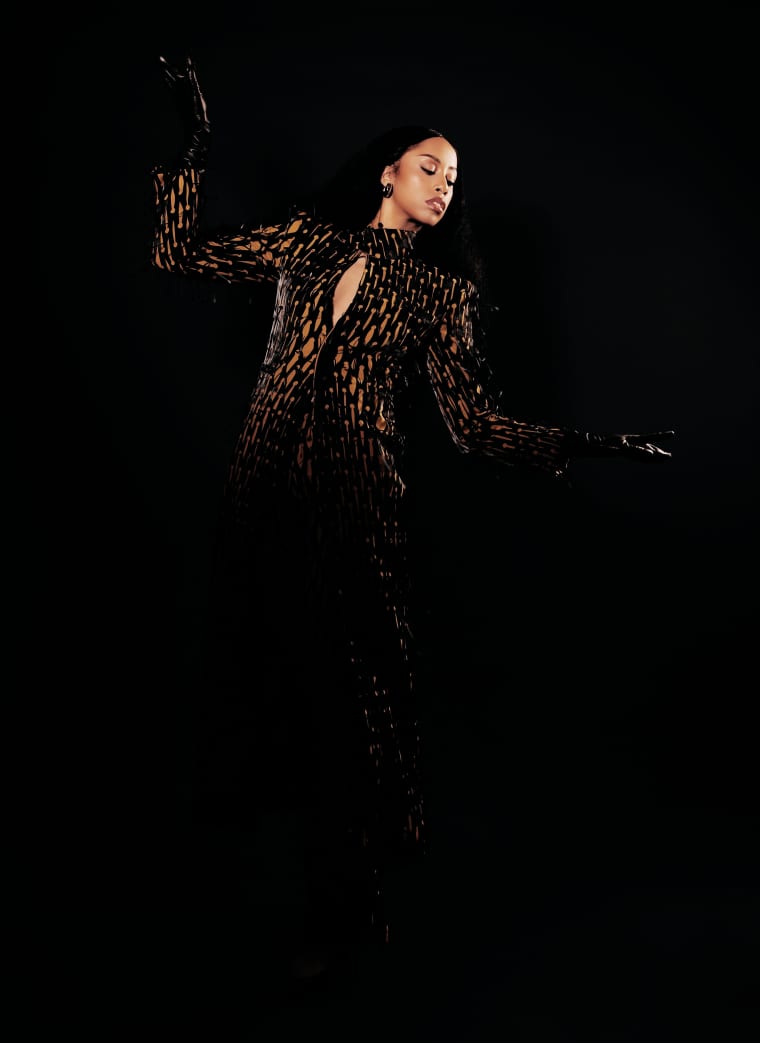
Together, they released her first mixtape, Alien Phase, in 2010. The sounds she was experimenting with then were pulsing and psychedelic, with her airy but commanding vocals floating in and around the melodies like smoke, billowing and dissipating. Her music now is a direct descendant of this vibe, albeit without the pop-rock '80s bite.
Back at the bar, we’re tucked so cozily into this corner of the lounge it feels strangely intimate for two people who just met on a photo studio set downtown two hours prior. I sense early on that her warmth and openness somehow belie a depth and level of complexity one might miss if they’re not shrewd enough to pay attention; her lightness a necessary contrast to how heavily she’s drawn to music of the night.
In high school, Jordan tells me she was insecure; she stood out due to her tall height, and was made to feel alienated by girls in her class. The isolation caused her to fall into depression; she was no stranger to battling intrusive thoughts, often questioning if she would grow up to be a beautiful woman, or accepted by those around her. Despite this struggle with self-esteem, she was always clear that she’d be a singer.
“I was a very different girl, but I had a purpose,” she says. “I still have evidence. I used to write in my agenda every single day: ‘God, please make me pretty. Please make me pretty. Make me a singer. Please make me a singer.’”
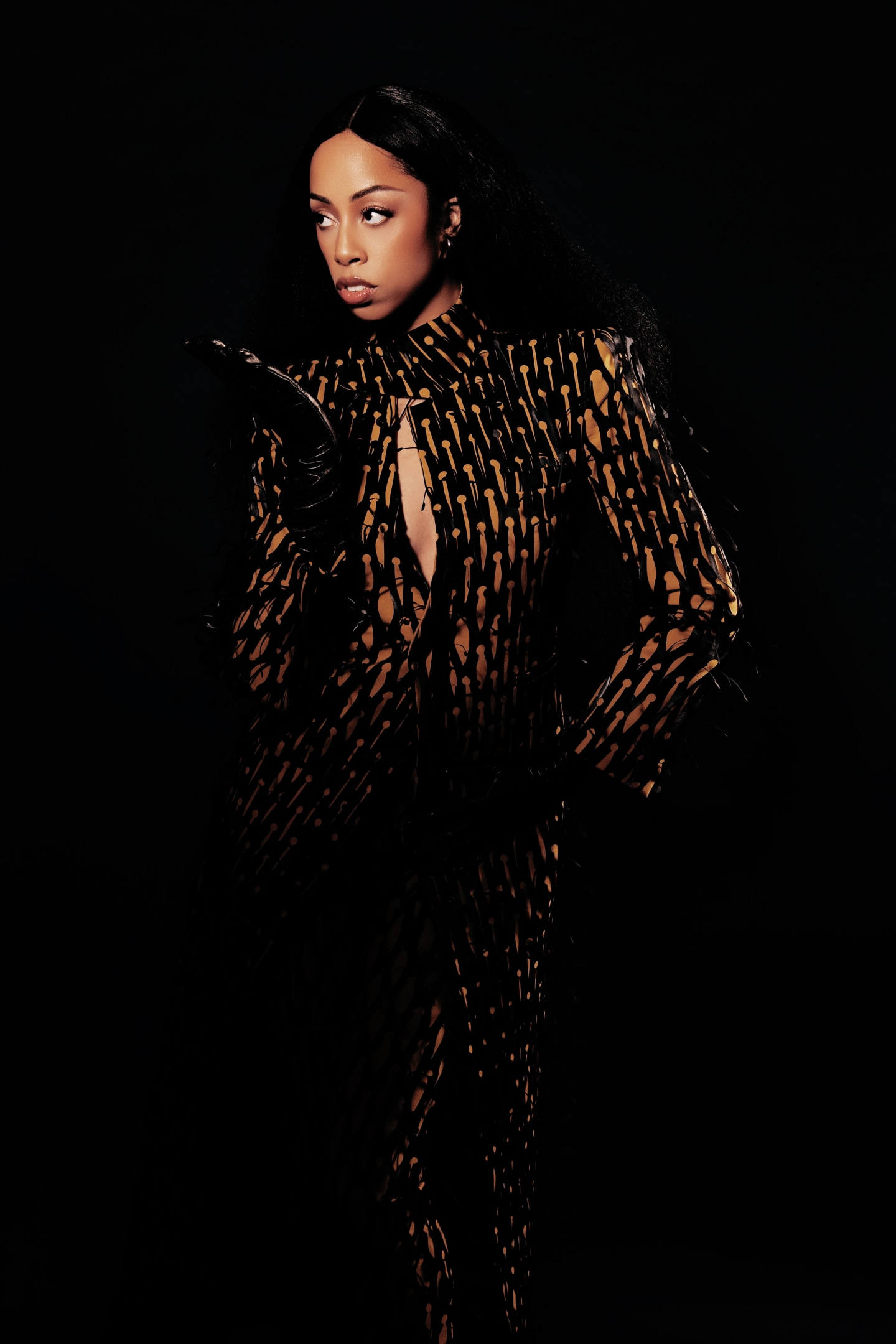 LUAR suit, WING+WEFT gloves, MISHO jewelry
She was unintentionally manifesting a future she is now enjoying, and is able to recognize an inner beauty and ease she possesses that radiates and has been hard-won. We agree that the blessing and curse of having a star power that others don’t necessarily possess is that it can be dangerous when others identify it before you do. Sometimes, they prolong the time it takes for you to understand your own value by shutting you out of mainstream conversations, by convincing you that you’re ahead of your time or too left of center, hoping that you’ll lose faith during your ascent. Luckily for Jordan, she possesses the virtue of patience.
I had started to play Through The Wall on my afternoon drive winding through the hills of Bel-Air, but daytime doesn’t do Jordan’s sonic world the same justice the mystique of midnight does. There’s something about the absence of sight that strengthens the presence of sound. When you listen to the Kaytranada-produced track “The Boy” or the fan-favorite “Bite the Bait,” the beats almost insist on being the soundtrack to getting ready for a night out, riding to a party, slinking across a dance floor.
I was a very different girl, but I had a purpose.
 KWAME ADUSEI coat, WOLFORD tights, LAQUAN SMITH skirt, STYLIST'S OWN top and shoes
Two days after our initial meeting, I arrive at an unmarked, if-you-know-you-know style venue in downtown Los Angeles for a show celebrating the Best Remixed Recording nomination of producer and DJ Ron Trent, a pioneering architect of deep house. Jordan is one of the performers tonight, and she steps onstage in a svelte all-black outfit made more ‘80s by pantyhose and dance shoes. Her shock of characteristic, wavy tresses and bangs illuminated by hot cobalt and magenta lights on stage makes it clear how much of a student she is of the genre’s history, while also being an Afrofuturist. The crowd engages with her (no distracting cell phone screens in sight), and the front row in particular recites her lyrics back to her so loudly and accurately it’s as if they’re reading them off a screen during karaoke. Suffice to say, they’ve definitely had the songs on repeat.
The title Through The Wall came to Jordan in 2022, one year after the singer felt people finally “got” her 2021 record Play With The Changes. “I think [knowing] the title in and of itself helped lead the way to a mentality that was going to be born…[like I’ve] broken through. It was almost like a manifestation that I didn't realize was happening,” Jordan says.
Perhaps she didn’t realize the breakthrough was happening due to the years and sweat equity she’s already put into her career. Over time, navigating myriad stops and starts and changes in management, Jordan says she’s had to shed a lot of the shadows of self-doubt and imposter syndrome. She recalls countless instances of hearing “no” and being made to feel like she didn’t have an audience, which she credits with her vision being misunderstood by executives, but also with the broader culture’s reluctance to celebrate a Black woman in house and dance music before albums like Beyoncé’s Renaissance helped awaken the public to the possibility.
 KWAME ADUSEI coat, WOLFORD tights, LAQUAN SMITH skirt, STYLIST'S OWN top and shoes
Paradoxically, Jordan felt the fanbase that she was building began to develop territorial feelings about her — a sense of gatekeeping her and her music.
“I have to let it be known to my fans, gatekeeping is like poison for an artist, but I kind of get where they’re coming from. Sometimes we like to hold the things dearest to us closest to our hearts,” she says. “I think a lot of my fans feel like once the world knows me that my magic will be lost, but that's not necessarily what happens as artists. We're always evolving. And also, I'm not a fairy, you know what I mean? I'm a real human being. It might feel magical to you, but like, this is also my real life.”
Jordan credits divine timing with the reason the world is finally catching up to the world she and KLSH have built, but also notes that finally finding the right team for her and her career has been invaluable. In 2024, she signed with independent record label EMPIRE, who describes her as the “most important” piece in the dance music roster of artists they’re building.
 KWAME ADUSEI coat, WOLFORD tights, LAQUAN SMITH skirt, STYLIST'S OWN top and shoes
 KWAME ADUSEI coat, WOLFORD tights, LAQUAN SMITH skirt, STYLIST'S OWN top and shoes
“Her talent precedes her, she’s been doing records and been ancillary to some of these big dance records and we felt like she needed to get her shine,” Tina Davis, the president of EMPIRE, says. “It was her idea to market [Through The Wall] without mentioning all the superstar Grammy producers on her project; we never highlighted any of the producers, we highlighted her. I think that’s what was needed, and that’s why she’s getting the recognition.”
Jordan adds of Through The Wall, “Something within me changed in the making of this body of work, I think I came to a point spiritually where I was able to really dip into gratitude and be so thankful to God for still being here, but also recognizing the footprints that we left behind musically. Like, wow, Rochelle, you really did this. You have a lot to be confident in moving forward, because you and KLSH single handedly developed your sound and style where now you're bringing in producers and people that are coming to your world that you generated over a decade [ago].”
I think [knowing] the title in and of itself helped lead the way to a mentality that was going to be born. It was almost like a manifestation that I didn’t realize was happening.
Backstage, before the show, Jordan, who doesn’t drink alcohol or smoke, prays, stretches, and watches live performances by Janet Jackson. “I like to take notes from the queens just a little bit to get me in the mood,” she says. Her stylist, MALU, is nearby, getting her night’s look ready. “You really have to make sure things fit,” MALU tells me. “On stage, she can’t wear strapless tops. I’m always thinking about what’s functional but also chic.”
Since the start of her career, and especially now after Through The Wall’s success, Jordan has drawn comparisons to the legendary disco divas she grew up listening to, including Donna Summer and Tina Turner, along with closer contemporaries like Whitney Houston, Aaliyah, and Mariah Carey. They are comparisons that her team and label has welcomed. “As of 2025 there hasn’t been another Donna Summer,” Davis muses. “We need that lane filled again, and there’s no one else that can fill that lane but her.”
 KWAME ADUSEI coat, WOLFORD tights, LAQUAN SMITH skirt, STYLIST'S OWN top and shoes
But how to distinguish a reference from a facsimile? The former uses echoes of the past to demonstrate reverence, the latter lazily emulates a sound without living in it. Jordan says she’s always strived to find the middle ground. “I’ve always liked something a little bit to the left, I don't want it to be so on the nose or predictable. I like music that almost terrifies me to hear – things that are just jarring and off the wall, but also relatable [and] that reminds me of things from the past that I fell in love with.”
In this sense, 36-year-old Jordan is at once the past and the future, a remarkably humble yet talented artist who understands honoring a legacy and being an innovator in equal measure. “We look at Tina Turner, you watch the documentary or you read her book, and you hear the story of how long her journey was of being in the industry and becoming the Tina Turner [at 44],” Jordan reflects. “I've had one of those long journeys as well that's created this strong woman. I think it's very helpful for women to know that you're worthy and you have so much value throughout the course of your entire life.”
Jordan is less concerned with virality than she is with longevity, prioritizing timelessness over trends. She emphasizes how little she’s concerned with the industry as a machine, and how instead she is more “entertained at the thought of entertaining myself.” She is her first audience and ear, constantly looking for new boundaries to stretch and deltas to hit in her music. “What I really want to hear from myself is myself evolve…” she says. “I'm always searching for a melody that's not predictable. [That’s my] theory: always try to find something that's out of the box.”
 KWAME ADUSEI coat, WOLFORD tights, LAQUAN SMITH skirt, STYLIST'S OWN top and shoes
I ask Jordan about her lyrical inspirations, impressed by the way she writes in such a passionate yet cavalier way about desire (and bashfully admit that some of her storytelling, particularly about the promise of love before it vanishes like a mirage, resonates with my own life). It is powerful, albeit puzzling, to hear a talented, fully embodied woman reveal that she too is occasionally brought to her knees by the illusion of true connection. Is Jordan more inspired by heartbreak, or by falling in love?
“I feel like for me now, where I am, falling in love,” she tells me, after mulling for a few beats over the question. “The curiosity of what love is and what self love is and looks like. Even in a love song, where you feel like it's [about] two people, sometimes it's [about] looking in the mirror for me.”
I’ve always enjoyed people who are accidental philosophers, casually punctuating conversation with miniature profundities that not only make one think, but feel. It makes sense why Jordan’s music strikes a unique balance of embodied but totally celestial, and somewhat impossible to touch — she is here but also not here; present but able to quickly retreat into the portal of her own mind. After a brief pause, she begins musing on a heavy expectation that’s recently been weighing on her.
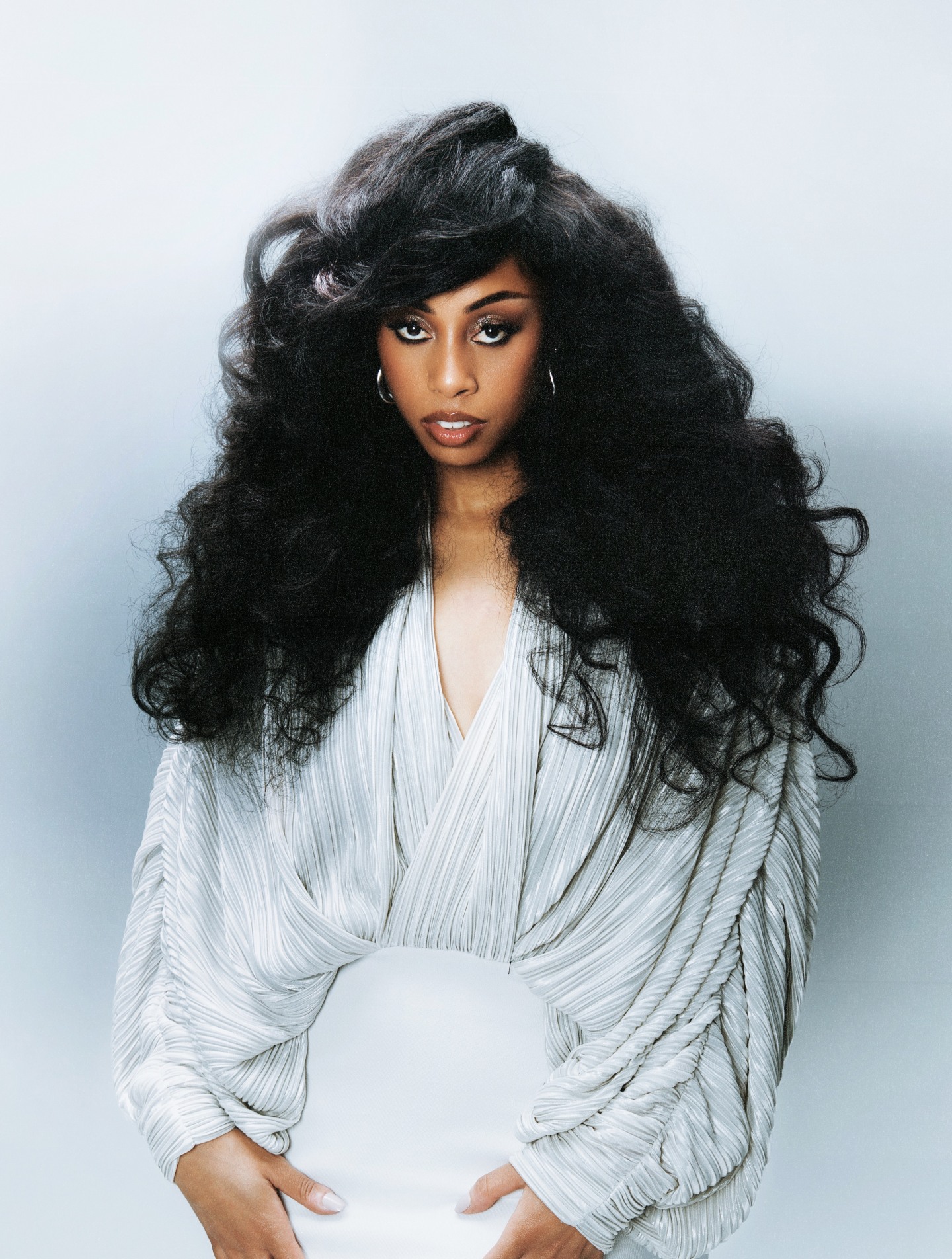 THE RUBY LA dress; MISHO jewelry
“One thing about being an artist [is that] there's a sacrifice that happens. So that magic that made me an obsessed consumer… when you become the artist, you learn the trick, so the magic goes away.” She clarifies that this advice is important for other emerging musicians to hear, most specifically. “Now you're the one creating magic for others, but you might not be able to feel the magic anymore like you once did, so it's a sacrifice. It's pretty hard to be the same consumer that I wish I could still be. But I'm supposed to do it. I'm supposed to give people magic.”
Three nights after her performance downtown, I watch Jordan commit to this sacrifice — and conjure this magic — as she shoots her music video for “Doing It Too” on a strikingly minimalist yet eye-catching set in Glendale. Observing take after take of her incorporating note after note, hitting all the marks and inventing some too, I am struck by how much precision there is in appearing free.
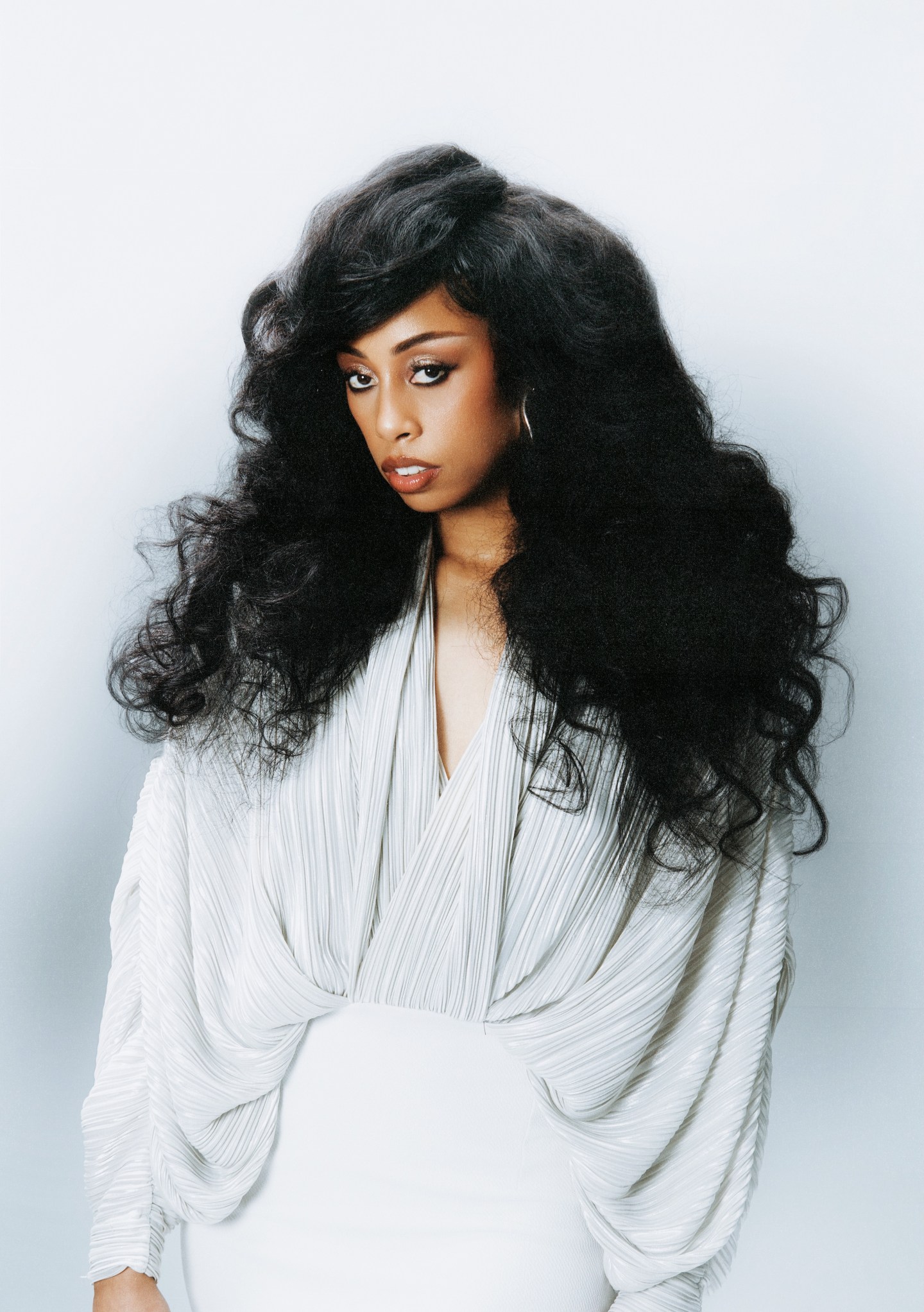 THE RUBY LA dress; MISHO jewelry
Consistently having to create magic sounds depleting even if it’s rewarding; Jordan says she’s been incorporating various grounding practices, which include rooting herself in nature to balance her chakras, in her daily routine to keep herself balanced. “It reminds me that God is the ultimate bringing me through. No matter what happens in life, I know there's a bigger purpose that's beyond me, and that my purpose is to give people a break by escaping into a world of sound,” she muses. This year, as she faces her biggest U.S. tour yet, she is focused on the theme of surrender.
“There's a lot in front of me and there's a lot behind me. What I've learned from the journey is that surrendering is the only thing, and the best thing, you can do. It clarifies for yourself that you can trust in yourself and a higher power to guide you through. As intense as things are going to become, I'm just going to go with the flow and attack everything with grace and surrender to the moment.”
Additional production credits:
Hair by Kaleel Joy
Make-up by Luigi Chamorro
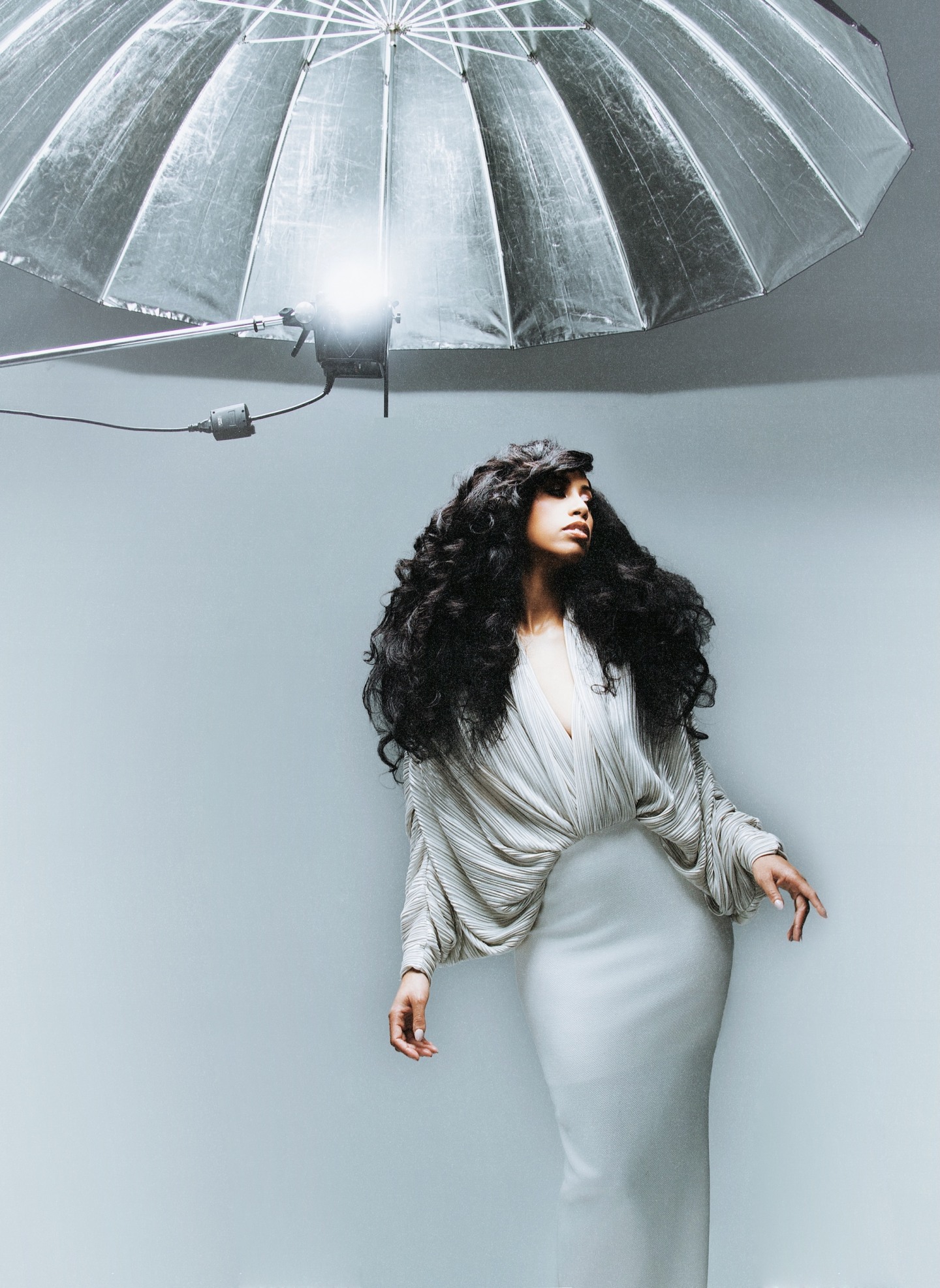 THE RUBY LA dress; MISHO jewelry
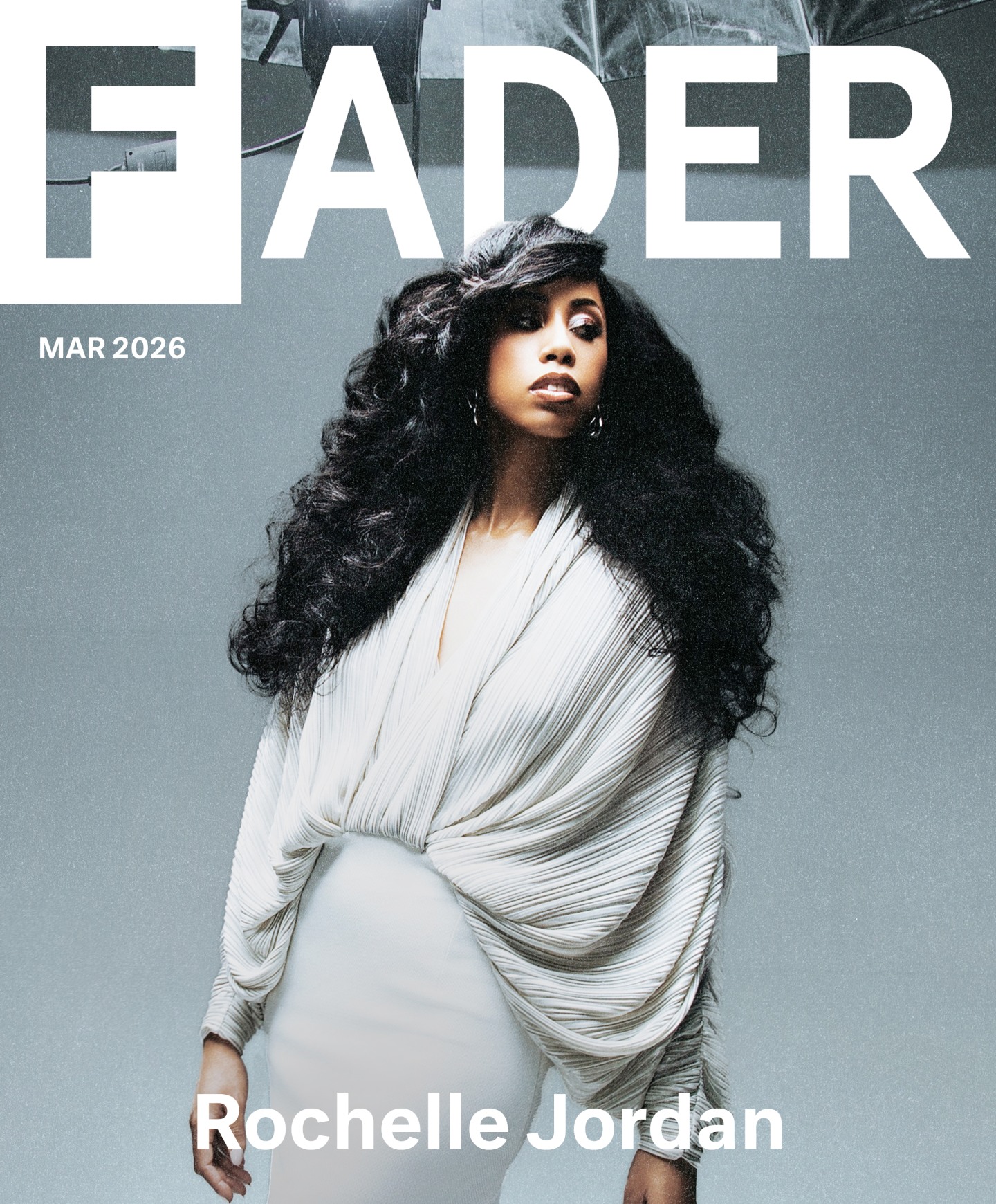 THE RUBY LA dress; MISHO jewelry