Photo courtesy of Fresh Made It/ Defiant Records
During the waning moments of an October interview with The Breakfast Club, Harlem’s preeminent diplomat Cam’ron spoke frankly about his frayed relationship with the neighborhood that raised him for the first 20 years of his life. “It ain’t the same for me,” he admitted. “It’s just not the Harlem I grew up with.” He wryly gave examples of the shattered glass, vacant lots, abandoned buildings, and the sense of community he now feels disconnected from. “I would sometimes shoot videos in [my man’s] building,” the Purple Haze rapper-cum-sports talk show host explained. “Now I gotta talk to somebody white to go into a building that I’ve been going to my whole life to get permission to shoot something on the roof.”
In the seemingly endless conversation around gentrification’s social ills, Harlem continues to stand out as a testament to how capital can slowly crush a neighborhood. The “urban renewal” efforts of the early 2000s transformed the storied Black neighborhood into aesthetic trimmings meant to appeal to higher class renters who could benefit from Harlem’s cultural legacy without actively participating in it.

The stretch of Lenox Avenue that Cam’ron called home typifies this fissure. The formerly rent-stabilized Delano Village was acquired in 2006 and transformed into Savoy Apartments. The historic Abyssinian Baptist church has become a tourist attraction, with visitors gawking at the gospel choir during the weekly 11 a.m. Sunday Service. Remaining indicators of what the community used to be are discreet and largely relevant only to longtime residents, such as the mural for Big L or the Minisink Townhouse – vestiges of a community long since fractured and sold for parts.
While these memories strike a sense of melancholy in the Dipset frontman, by his own admission, Harlem hasn’t been his home for over 20 years, having long absconded to suburban enclaves of New Jersey after becoming a celebrity. But not everyone has the fame or wealth to make the same choice – more often than not, the remaining residents are abandoned to a liminal space between Harlem’s past and a future vision they are not welcome to participate in. Few people encapsulate the delicate tension between the neighborhood’s past, present, and future better than Max B.
For native New Yorkers above the age of 30, Max Biggaveli is as endemic to Harlem as the Apollo Theater. When he emerged in 2005 with “G’s Up,” his entire persona seemed to be a fever dream of every trope assigned to a slick-talking Harlem cat: a knack for wordsmithing insults and compliments with aplomb; an almost reflexive trigger for claiming inconceivable feats of human accomplishment (which could alternately be construed as lying); a weakness for indulging in vices and hustles; and a fastidious attention to personal grooming. Even his moniker, Biggaveli, is evidence of his affinity for theatrics, the surname being a crude portmanteau of Tupac’s Makaveli persona, Jay-Z’s “Jigga”, and Notorious B.I.G.’s original stage name, Biggie Smalls. “You not wavier than the wavy man,” he quipped in a 2008 interview for The Come Up DVD, his shoulder-length permed hair flowing with the wind. “I got a better car, I got better songs, I look better, I got more b—es, nigga, I just live better than you.” Well before the modern understanding of memes, his one-liners reverberated to his fans and propagated through platforms like YouTube and WorldStarHipHop, affording him infamy well into the 2010s and beyond.
By 2008, Max would be publicly at odds with the Diplomats’ Jim Jones after years of helping construct melodies and songs for Jones and Cam’ron. After a robbery gone wrong landed Max B in prison with a $2 million bond, Jones bailed him out in exchange for acquiring all of Max’s publishing to date. (Later, Jones would sign a major label deal at Columbia off of the hook Max B wrote for “We Fly High.”) Max’s understandable public resentment not only generated once-in-a-lifetime interview one-liners but a deluge of records that would ultimately become cult classics for Uptown New York City: “Sexy Love” and “She Touched it In Miami.” He also began collaborating with a then-emerging young Arab rapper from the Bronx, French Montana, on a mixtape series called Coke Wave, that brought Montana’s visibility to new heights.
Even his moniker, Biggaveli, is evidence of his affinity for theatrics, the surname being a crude portmanteau of Tupac’s Makaveli persona, Jay-Z’s “Jigga”, and Notorious B.I.G.’s original stage name Biggie Smalls.
 Photo courtesy of Fresh Made It/ Defiant Records
By multiple artists’ accounts, including mentor-turned-nemesis Jim Jones, Max would serve as one of several early progenitors of the melodic rap record that is a staple in present-day hip-hop. A Boogie Wit Da Hoodie’s “Look Back At It” is a prime example of Max B’s style of song-making being distilled for a new era of New York hip-hop, from its cocksure lyrics to its use of sample. At present, “sexy drill” pioneer Cash Cobain is the most prestigious carrier of Max’s mantle, with his signature style of sampling and hi-hats resulting in irreverent malapropisms such as “Rump Punch.”
Unfortunately, Max would only see the impact of his melodic innovations in brief glimpses. After his 2007 indictment for the 2006 robbery he coordinated in New Jersey that ended in a murder, the rapper was convicted at trial for nine out of 11 charges, including felony murder, and was sentenced to 75 years in prison. After multiple attempts at appeal, his sentence was successfully reduced to 20 years; in November 2025, he was released after being incarcerated for 17 years.
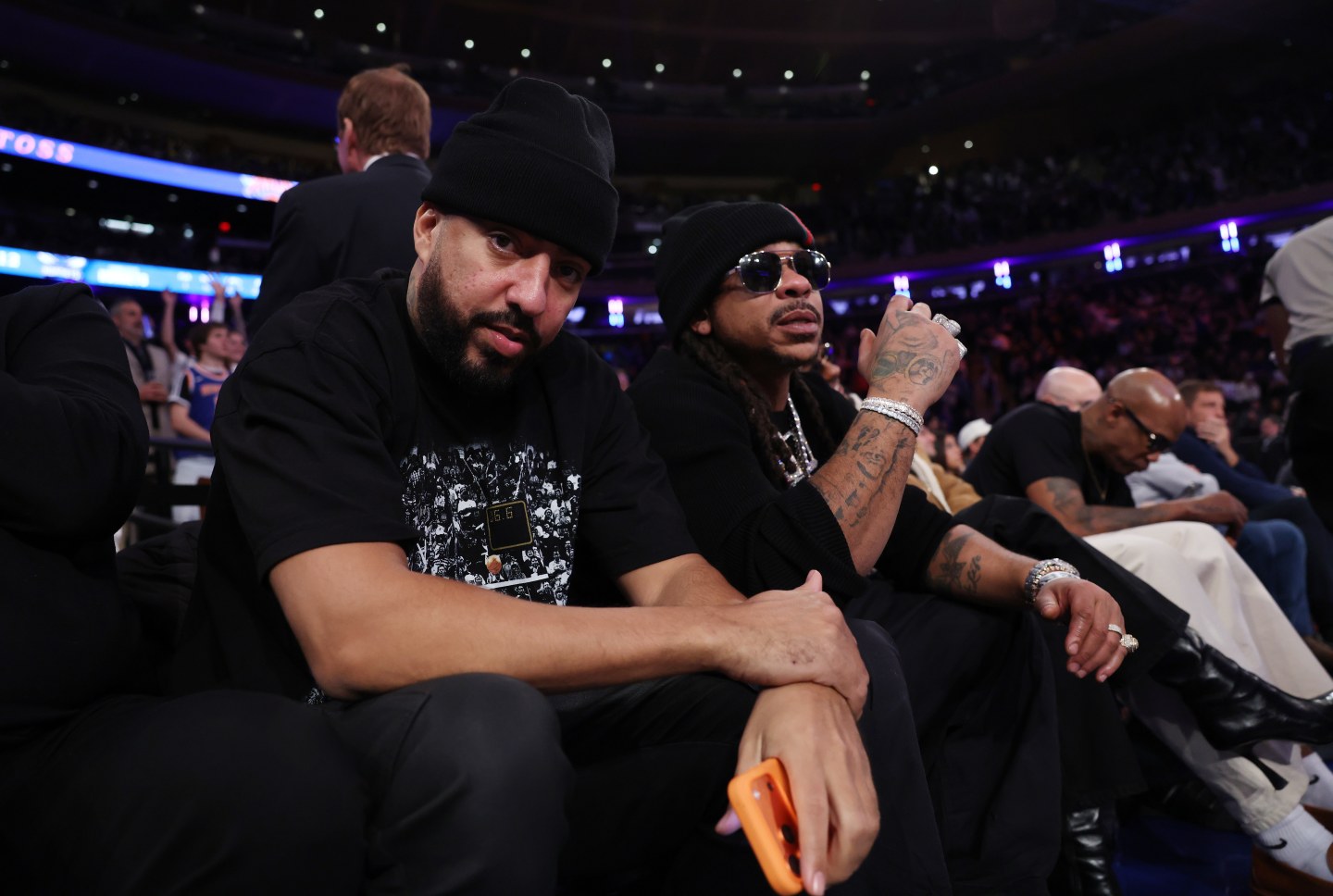 French Montana and Max B.
Kenneth Richmond/Getty Images
French Montana and Max B.
Kenneth Richmond/Getty Images
Max B returned to Harlem, but for all intents and purposes, he came home to a neighborhood that was wholly unfamiliar. While 17 years may have plodded by in prison, Harlem went through multiple life-cycles in rapid succession. The rise of the lauded A$AP Mob came and went, and many of Max’s former collaborators either pivoted — to acting, podcasts, entrepreneurship, or some combination of all three — or passed on.
His lauded homecoming was equal parts exhilarating and disorienting. Almost instantaneously, he was engulfed by a flurry of podcasts, interviews, and live appearances galore, as if he exchanged the panopticon of prison for the constant surveillance of a smartphone. In many ways, the frenetic obsession made sense; the Wave God’s potential resurgence is the ultimate reference point for the Harlem of most hip-hop fans’ imagination; one where “Harlem World” functions as both a label and a reflection of how a square mile of upper Manhattan can feel central and all-consuming to the point of myopia.
Nostalgia, however, can be a dangerous narcotic when not employed with caution. At its best, a fascination with Harlem’s creative spirit births artists the likes of A$AP Yams and Teyana Taylor; at its most unmoored, it can give way to an endless loop of anachronistic chest-thumping that, from the outside looking in, reads as a painful fealty to ego over reality. One need only look at Roc-A-Fella co-founder Dame Dash’s recent gasps at virality as an ominous foreshadowing of how pride can ultimately crater into abject desperation.
The ultimate test of Max B’s viability in a modern New York hip-hop scene came in mid-January with two back-to-back shows at the Brooklyn Paramount. Fresh off the release of a new collaborative Coke Wave mixtape with Montana and the buzzy single, “Ever Since U Left Me,” the question on everyone’s mind was could the Silver Surfer convincingly portray something resembling a return to form?
On a snowy January weekend, the mid-sized Brooklyn venue quickly swelled to capacity for Max B’s Sunday evening show, which kicked off promptly at 8 p.m. NYPD enshrouded the concert, cascading in and out of the venue at will as a means of displaying an intimidating show of force. Most notable, however, was the demographics of the crowd: in an era when hip-hop is pop culture, it’s an anomaly whenever an audience is not only overwhelmingly Black, but also made up of born-and-raised millennial and Gen X New Yorkers, clad in Avirex jackets and all.
The first half of the show functioned as a leisurely trip down memory lane: in quick succession, the charismatic performer (who has since traded his relaxed hairstyle for chunky plaits) rattled through beloved b-sides like Vigilante Season’s “Where Do I Go (BBQ Music)” and “Sexy Love,” which prompted an uproarious response from the audience. While the rapper relied heavily on a backing track to support him, his charisma outpaced his performing capabilities, encouraging the audience to engage in numerous rounds of enthusiastic call-and-response. Without missing a beat, thousands of New Yorkers were proudly rapping, “Why you do that? I said, ‘I'm sorry, baby / that was Biggaveli not Charly, baby,’” filling in every adlib and quip that had been committed to memory. Halfway through the setlist, Max looked out into the audience with pride. “Damn, y’all some wavy ass motherfuckers,” he crowed.
The Wave God’s potential resurgence is the ultimate reference point for the Harlem of most hip-hop fans’ imagination.
 Photo courtesy of Fresh Made It/ Defiant Records
The weak points grew more pointed when it came time to debut his new music; by the time Max hit play on “Ever Since U Left Me,” the positive reaction was dulled by the fact that French Montana wasn’t present. A coterie of guest performers, ranging from Red Cafe and Lola Brooke, was tacked into the setlist in a meandering and unstructured way. At times, the rapper would diverge into rambling monologues of varying impact: boasting about how the state tried to keep him for 75 years, and comparing his devout fanbase to Swifties. In an honest moment, he revealed how hard he had been working since being released from Newark’s Northern State Prison. “I’ve been out here trying to just deliver the product for the people,” he said to roaring cheers. “But you know what, it pays off… This was the waviest two weeks ever.”
But there were glimmers of what a polished show could look like when fully realized, moments that almost all revolved around his ties to the past and present of Harlem: remembering Stack Bundles with their collaboration “Fucks With You;” paying homage to A$AP Yams with “Yamborghini High” and “Revolution;” a moment of memoriam for Chinx, scored to the new single “Nigga Like Me.” In those moments, Max briefly transformed into Harlem’s personal hip-hop Dr. Who, with the stage functioning as his TARDIS. Those brief glimpses alone were worth the price of entry, briefly hinting at how the melodic rap’s crown prince could successfully reintegrate into the music industry as an elder statesman of hip-hop, rather than an antiquated act desperately chasing youthful trends; or, perhaps even worse, a grizzled rapper who spends his days trying to convincingly cement their place in music history to a generation of fans who struggle to connect to his relevance.
The Harlem of Max B’s imagination may very well be a myth, but in many ways, the neighborhood has always thrived as a fantasy. “Harlem is neither slum, ghetto, resort, or colony, though it is in part all of them,” Harlem Renaissance writer Alain Locke once stated. “In Harlem, Negro life is seizing upon its first chances for group expression and self-determination.”
It’s in that spirit that Max B, for all of his anachronistic flair, continues to embody Harlem’s essence. It’s the Harlem of Dapper Dan, Murda Ma$e, and the Boys Choir of Harlem (where he once went to school), where accomplishing your wildest dreams is just a well-crafted hustle away. Artists like Max offer glimpses into the ambition, grit, and whimsy that remain etched in the neighborhood’s cement sidewalks, one 16 at a time.
 Photo courtesy of Fresh Made It/ Defiant Records
In January, a new artist named Fergie Baby began gaining local fanfare for using a classic style rooted in the uptown bravado Max B perfected. “Harlem is heaven,” he clamors in the opening seconds of his new record, “Good Day To Be In Harlem.” Not long after the song was released, Fergie shared footage of him in the studio with Max, promising a future collaboration. Therein lay the magic of Harlem: while change is inevitable, the neighborhood remains in constant dialogue with its past, present, and future. Old Harlem may be long gone, but as long as Max B is willing to be the architect of its musical memory, he will remain indispensable.