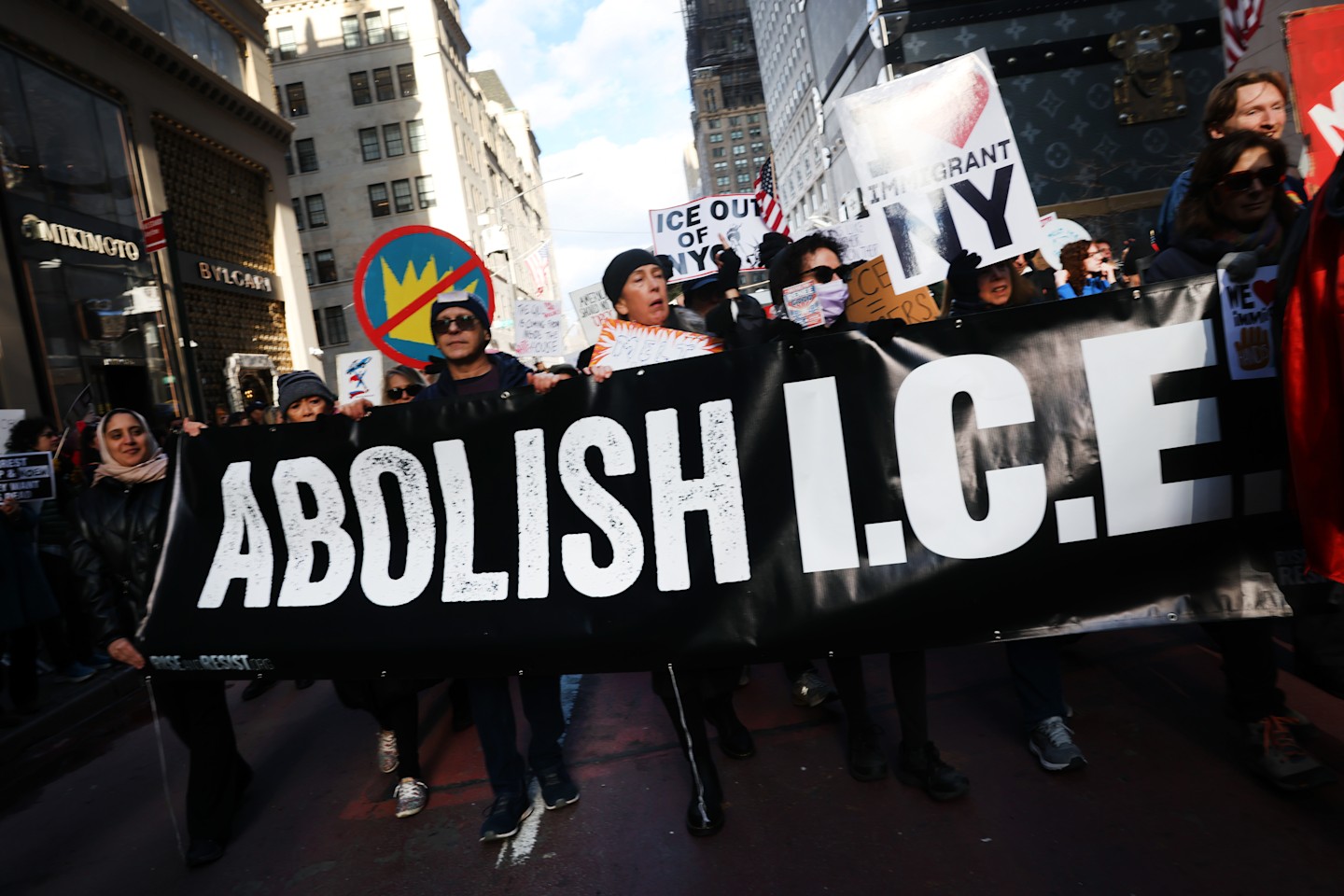
 Photo by Spencer Platt/Getty Images
In September of 2025, Bad Bunny revealed in an interview with i-D that he purposely avoided touring in the continental U.S. due to a fear of immigration raids targeting his fans and shows. His admission was a sobering one.
Since Trump stepped into office in January 2025, ICE, or U.S. Immigration and Customs Enforcement officers, have conducted raids across the country, targeting not only workplaces but also private residences and in some cases apprehending civilians while on their way to school or leaving their Green Card interviews.
To date, no large, high-profile music event has yet been impacted by an active ICE raid, but the threat is real. In January, concertgoers at an all-ages Minneapolis rock venue were pepper sprayed by ICE agents, while in April, Chicago's Cinco De Mayo parade was canceled due to concerns over immigration enforcement and safety. Even this year's Super Bowl, where Bad Bunny played its halftime show, worries around an ICE raid were high.
Kim Warnick, a program director at the progressive, anti-authoritarianism non-profit Western State Center, says she's received an influx of concern from independent venues and artists as ICE and CBP ramp up violent tactics as arts and culture programming continue to be under attack by the Trump administration. And with the lack of industry-specific ICE-related resources for music businesses, her team put together a free guide to help venues around the country understand their rights and protect their communities. "Continuing to figure out how to be in community with each other is real resistance in this moment," she says.
Ahead, Warnick breaks down the guide in her own words and shares how bystanders can educate themselves in case of an ICE raid.
Designate staff members to handle all communication with law enforcement or ICE
KIM WARNICK: We want people to think about placing safety first and upholding our rights. [Part] of it is thinking about who on your staff can you designate to be the person who will talk to any law enforcement, whether it's ICE or CBP or the sheriff's department. Who on your team are you going to invest more training into, who you feel confident can stay calm and collected when people with tactical gear and masks and guns are yelling in their face? Because it certainly should not be all of your staff.
And then, how do you make sure to communicate that to everyone so they know, Hey, if this happens, here's who you call. Your job is not to interact with this group, but it's to say, 'Let me call my manager, or whatever it is.
Build connections with your community
WARNICK: We really recommend building connections with your community. Who are the legal immigration rights organizations? Is there a hotline you can call if there is sort of enforcement activity or a raid or something else? Who are the folks that you're going to call on if this happens? We recommend reaching out before.
You don't need to do like a huge amount of relationship building, but even an email saying, Hey, we have this event coming up. We're a little worried that there could be enforcement activity. Is there a number we can call? Just taking those 15 minutes to reach out before something happens so you've already established an actual human you know at an organization. You're just not going to have the time to do that in an emergency.
We [recommend] having an emergency contact sheet; it can be part of a safety binder.
Know how to distinguish who's at the door
WARNICK: If someone's at the door of your event and trying to enter, what do you do? The manager or security manager, whoever it is, will need to know how to distinguish, "Who am I talking to?" Is this a law enforcement? Is this a sheriff? Is this an ICE agent? Is this just a guy in a mask?
It is confusing to understand who folks are because ICE is operating rogue and trying to not share who they are. We have some tips on the different badges you can look for, what you can do if, when you ask who it is, they don't tell you. (Editor's note: Per Western State Center's website: Look for shield-shaped federal badges or uniforms labeled Homeland Security. Agents in camo or other tactical gear often indicate ICE or CBP.)
Learn the difference between warrants (and what to look for)
WARNICK: We have pictures of what a legal judicial warrant looks like, and an administrative warrant, which does not grant legal access — it doesn't do anything.
This is not an agency that's following the law, so we really have to hold our own and know our rights. If you look at it and they actually have a judicial warrant, it doesn't give them access to your whole event just because they have a warrant. Warrants are much more narrow than that.
Don't bring people anywhere that don't have legal warrant access because ICE and other agencies can access a space with your consent. If you say, "Oh, come on into my office," and they didn't have a warrant for it, they can come. If an agent knocks on the door and says, "I got to use the bathroom," and you go, "Yeah, go ahead," you just gave them access to your space. [ICE agents] are not trying to follow the law. They are trying to be sneaky and get access in whatever way possible. It's on us to know how to hold the line.
Train and brief staff
WARNICK: Getting this information out to your staff, to your vendors, to all the folks who are part of your event team helps build confidence and trust with folks who might be feeling nervous.
It also makes sure that you can follow the plan because if someone working the door says, "Come on in," you can't walk that back very easily. You really want to make sure that folks, especially folks who are at access points, know your expectation for the event is do not let these people in at all. Their job is to say, "Let me call the manager."
Encourage attendees to stay calm
WARNICK: Our best ask for attendees is if this happens, try to stay calm. Calmness is in our favor here.
One of the questions we sometimes get is, "Should we make an announcement if ICE is there?" We try to get venues to think about it like any other show stoppage or emergency. How are you communicating if there's a fire, or if there's a weather emergency?
That helps the people who are there who might feel really scared to know that they're not alone and that you're not just throwing them to the wolves if ICE shows up. And if ICE shoves past anyways, you're going to document and you're going to do things to try and help them on the other side.
Attend a know-your-rights training
WARNICK: For people who love going to events, ACLU or Right To Be do these free online know-your-rights trainings. Your local immigrant rights group is probably also doing these community trainings. I really recommend going to one.
They're usually an hour long, and they give you a lot of information. Things that are helpful is sometimes filming, sometimes it's writing things down, sometimes it's saying, "Hey, you don't have to comply." It can be reminding people of their rights. Sometimes it's getting out of the way. It's rarely putting your body on the line, it's certainly not escalating the temperature.
For people who care about this and the events they go to are safe, sign up for one of these trainings. You can be a stronger ally and friend by taking that step to really be prepared.