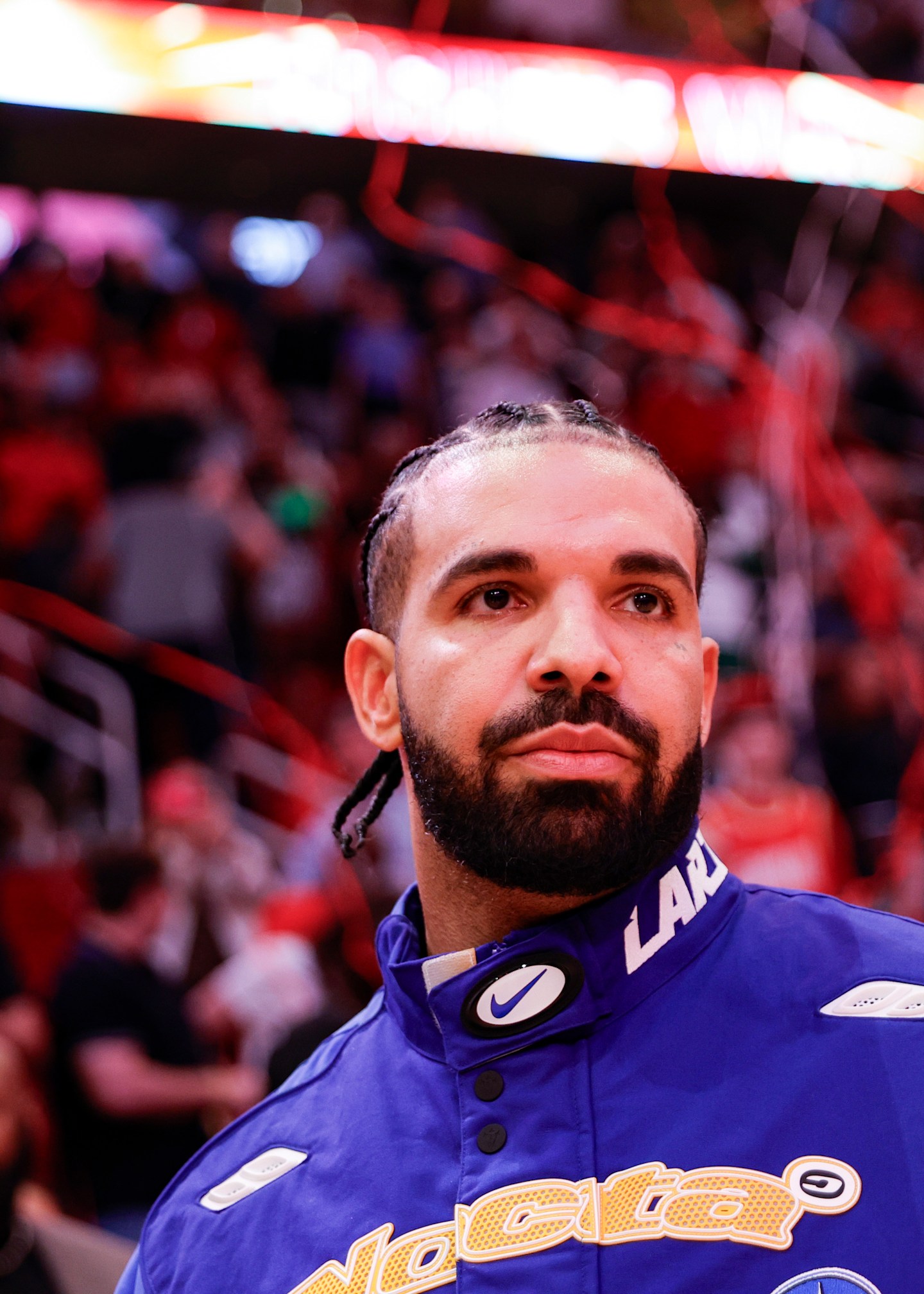
 Carmen Mandato/Getty Images
The image of Drake I could not stop thinking about this weekend comes midway through ICEMAN. On “B’s on the Table,” the rapper is exhausted but not depleted, surrounded by his dogs, his “bitch,” the two-Michelin star personal chef, and fairweather friends eager to text congratulations now that he’s back in the mix. “Sometimes I sit in the parking garage and I talk to my watch or I talk to my whip,” he intones. In all the ways that matter, Drake is alone, alone.
That’s nothing new. Over the past 10 years, Drake has entered rarified air, a popstar amidst rappers and a force amongst popstars. He’s been Teflon and platinum and diamond — even as critics have lambasted his records for diminishing returns — and found himself functionally peerless, no longer competing with anyone, not even himself. Just look at the cover of ICEMAN; Drake’s aiming for the sort of world-bending cultural ubiquity that turned an artist like Michael Jackson into a god among men. Upon release, his three albums that arrived precisely at midnight May 15 promptly broke streaming servers. Anything less would be blasé.

Read Next: 16 picks for Song of the Summer 2026
ICEMAN is a good album with flashes of excellence, but it’s not that good. While it’s likely fans will push at least one of these collective 43 songs to the sort of incessant social media omnipresence “NOKIA” enjoyed last year, nothing here is quite so inventive or unguarded as “In My Feelings” or “Too Much.” But this album does exactly what Drake needed it to do: remind people that his power comes from the music first, and Being Drake second. Instead of attempting to centralize his sound and his fans, he’s diversified, stretching himself to deliver a range of music that could hit everywhere from Ibiza to the Bay Area. Alongside slighter offerings, MAID OF HONOUR (okay) and HABIBTI (bomb), ICEMAN (solid) presents a vision for how Drake’s music might fit into the weave of our lives right now, offering up a version of Aubrey for every playlisting niche available.
Getting to that point with these three records has necessitated reflection, humility, and a general shift in posture. Drake remains the biggest rapper out, but two years on, he can admit he lost the beef, badly. He’s still assured he’ll win the war (if he hasn’t done so already by virtue of not dying), but jettisoning the ill-advised defensiveness of “The Heart Part VI” and “GIMME A HUG” makes that confidence aspirational rather than absurd. Crucially, this candor cracks open the Iceman’s armor, if only a little, and these glimpses of pain and paranoia ground Drake’s current position in an earnest humanity. Returning to “B’s on the Table” and Drake sitting in the driver’s seat of a car going nowhere, talking to himself because who could possibly give him advice: The gesture is unexpectedly relatable, like when you sit in the driveway for 20 minutes decompressing after a long workday.
Part of why Kendrick Lamar walked away with such a big win two years ago was a broader cultural resentment toward Drake hegemony; people might love a winner, but they rarely love them forever. Drake’s as cocky as ever on ICEMAN, but repositions himself as an underdog by shifting focus away from other celebrities to the record labels that pull strings behind the scenes. “Fuck it I’ll battle the labels, fuck it I’ll battle the majors,” he declares on album intro “Make Them Cry.” “I’m fighting the man, not suing a rapper, you boys are not listenin’,” he hisses after a mildly transphobic line on “B’s.”
Whether or not listeners (or the courts) believe his theories about Universal Music Group and botted streams, they give Drake a villain to rail against and snipe at on wax, to remind us that despite his personal plane, cryptocurrency holdings, gambling partnerships, and the mansion so big he calls it The Embassy, he is still an artist under capitalism, tangled up in the industry as much as Taylor Swift and Justin Bieber. There’s a rumor online he dropped three albums as a way to fulfill the final obligations of his most recent record deal. “I just wanna be / freeeeeeeee,” he keens on “Make Them Pay.” Don’t we all.
On first listen, ICEMAN feels like business as usual: a fine-tuned blend of moody set pieces and mid-tempo resentment raps, interspersed with soaring synths and trap-influenced bangers. But Drake’s pettiest impulses are sharpened to a hilariously cutting edge. “‘Rack City’ bitch, we remember that,” he sneers at Mustard over a hyphy beat co-produced by Karri and P-LO. “Damn, you should try and get back to that.” On “Firm Friends,” he raps, completely stonefaced, “N****, K-Y-S A-S-A-P, that's some shit that you could do for me.” Or take obvious album highlight “Shabang,” where a paramour tries to get insider information on ICEMAN’s release and Drake threatens to take an opp’s girlfriend on vacation. “Am I upset? A bit – the last one you dropped was shit,” he shrugs. “I did press play on that hoe / midmidmid skipskip.” These songs are funny, breezy, and endlessly listenable, and you find yourself wishing ICEMAN had more of them.
In the end, too much of the album is given to moody tracks where he explores, however shallowly, the fallout from his beef with Kendrick Lamar: losing sleep, falling off the grid, obsessively reading the comment section. “What died back in 2024 was a big piece / so it’s like, this shit is me, but it isn’t me,” he confesses. “Y’all keep on asking what it did to me / that’s what it did to me.” Where the myriad Drakes we know and love might have coexisted on previous albums, in 2026 companion albums MAID OF HONOUR and HABIBTI serve as key flankers. These records are more cohesive than ICEMAN, benefiting from tighter runtimes and more focused sonics, but they’re rather uneven. Stunna Sandy sounds like a superstar on the truly incredible “Outside Tweaking;” ditto for Iconic Savvy on “True Bestie.” I’m partial to Qendresa, Sexyy Red, and Loe Shimmy’s work on HABIBTI, but large stretches of MAID OF HONOUR feel like outright bait, a way of hedging his bets and pursuing a club hit. The nadir has to be “Cheetah Print” with Sexyy Red, where the pair duet over an insufferable Peggy Gou sample on a song that practically feels AI-generated.
Over the weekend, I was looping the visualizer for “B’s on the Table” where we see soaring views of the CN Tower dominating the skyline, but also levitating shots from the tower’s interior, panning lovingly over the arterial tangle of pipes and wires within. The lifeblood of a Toronto icon. As my former coworker Jordan Darville noted last year, recentering on their home country is a typical tactic for Canadian artists who find American audiences less than hospitable, but I don’t see ICEMAN as a retreat. “I always used to be so envious, man, that Wiz Khalifa had that song ‘Black and Yellow,’ and it was just a song about Pittsburgh,” Drake told The FADER 10 years ago. At a pivotal moment in his career, it makes perfect sense that he’d recenter on his origins. That’s where legacies begin.