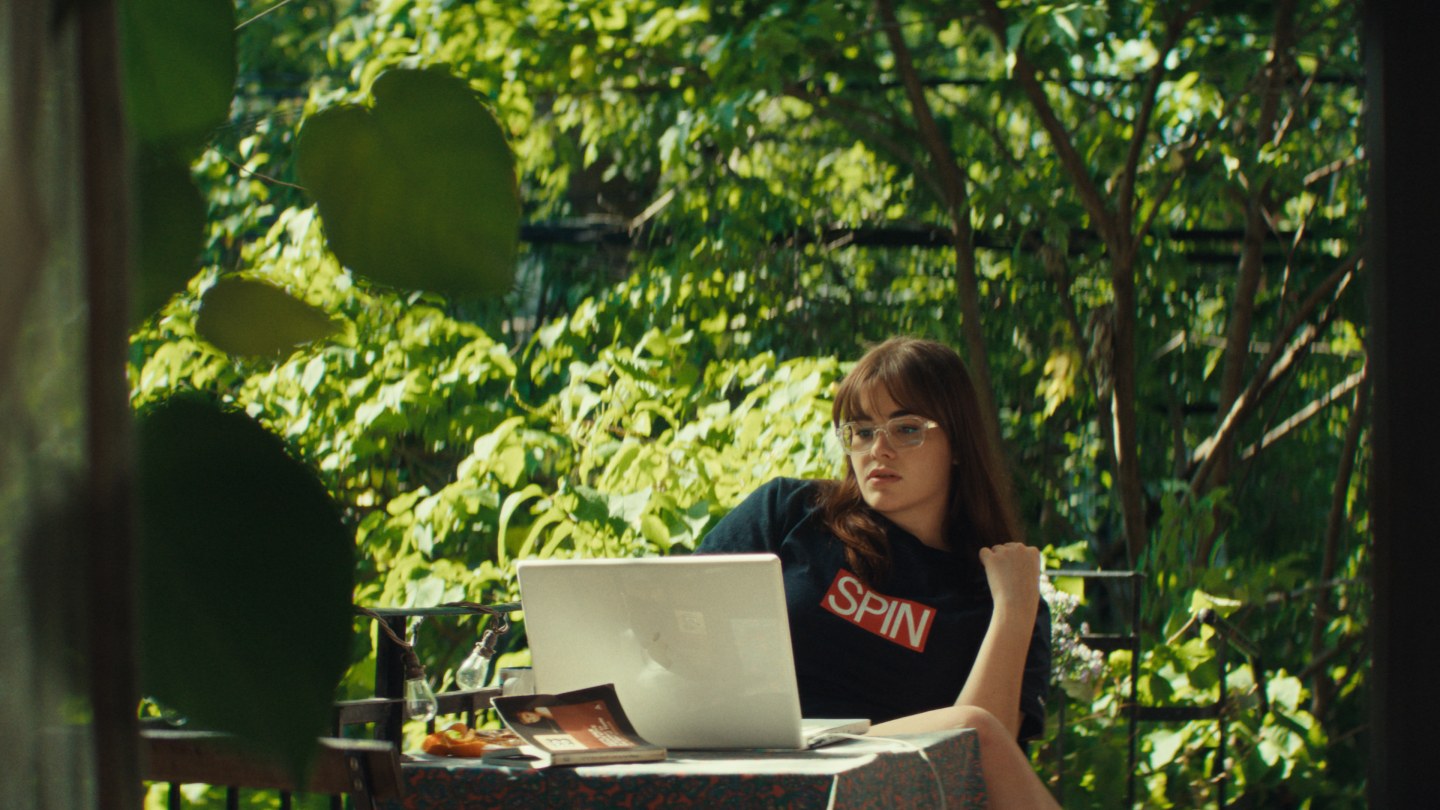
 Image courtesy of 'Mile End Kicks'
Music critics needed a win.
Haunted by pop star backlash, tied to a teetering music media industry, and facing the influencer-ization of our craft, us beleaguered music writers needed a chance to revel in the spotlight and feel fab for just one moment. Enter Mile End Kicks, in which a 22-year-old music critic (Barbie Ferreira) spends one hot and heavy summer in 2011 Montreal. Indie artists like Grimes and Mac DeMarco are roaming the streets, rent is graciously cheap, and eager anglophones from across Canada are flocking to the city in hopes of finding niche scene cachet.
Largely ignoring her contract to write a 33 ⅓ book on Alanis Morisette’s Jagged Little Pill, Ferreira’s Grace instead spends the season enmeshed in the city’s buzzing indie rock scene. Eventually she finds herself thrust into a love-ish triangle with two members of the rising local act Bone Patrol: the group’s sweet guitarist Archie (Devon Bostick) and its charismatic enigma asshole singer, Chevy (Stanley Simons).
Written and directed by Canadian director Chandler Levack, the film is semi-autobiographical. Levack was a music writer for the likes of SPIN and Canadian alt-weeklies, and like Grace spent a pivotal summer in the city during the peak of its cultural appeal. “It just felt like anything was possible,” Levack says of that time. “You’d go to these tiny loft shows at Silver Door, Torn Curtain, or Lab Synth, and see a bunch of bands mess around at two in the morning in a smoky warehouse. You felt like you were at the center of the universe.”
The film is a love letter to the power of music and Montreal and doubles as a coming-of-age-story that warns against the dangers of losing yourself in others. It is also a sweet portrait of a critic, finding meaning through the messy craft of writing.
Ahead, Levack talks about her own time in Montreal, working with local legend and SOPHIE collaborator Cecile Believe on the film’s score, and her Montreal music recommendations.
 Photo by Cobrah Snake of Chandler Levack, Barbie Ferreira, Devon Bostick, and Isaiah Lehtinen (left to right)
The FADER: Can you tell me about your own experience coming to Montreal in the 2011 indie era. What was in the air at that time?
CHANDLER LEVACK: Even though it was such a small scene of largely Anglo expats from Calgary, Vancouver, and Toronto making art there, it was also just very genuinely exciting. To walk around the streets of Mile End, you sort of felt invincible, like you owned it. Which is a funny irony because you're living in a place that's full of French Canadians and other people. But there was this small world of walking down Saint-Viateur and feeling like you're seeing every single person that you knew. It was like walking the halls of a high school.
The music writer grind is very specific. It can be chic and glamorous at times, but also really frustrating and maddening. You were a music writer. How do you remember your time in the trade of music writing?
It’s weird because you do feel cool and part of a scene because you have this weird power of being on "the list," writing with your notepad, reviewing the show, and getting CDs ahead of time. But there's so many little indignities to it as well, like begging editors to pay you and getting paid in CDs and stuff. It's a job selling the idea of "cool." And bands are always inherently cool, and it always feels intimidating to talk to musicians. But a lot of the musicians that I spoke to were so warm, lovely, funny and idiosyncratic. There's something about the quality of music and writing about music. [Music is] such an ephemeral thing that you could be a little bit more lyrical. When you describe a song, it’s like you get to write poetry a little bit. It's less technical than being a film critic, which I sort of transitioned into after that.
 Photo from 'Mile End Kicks'
I know you wrote the film a long time ago, closer to the events where it takes place, and only recently returned to it. What stood out to you when you re-examined the material?
I was really scared to read the script again because I’d invested so many years in writing it, and then I made I Like Movies. I wasn't sure if I still related to it anymore or if it even was good. And then to read it again, I was surprised by the pace of it and how quickly it moved. When I first wrote it, I was 27, which was only four years removed from the summer that I lived in Montreal. Then when I actually went to camera with the movie, I was 37. It was interesting to see my perspective change like, "Oh, I understand this situation or dynamic better," or “I can see the kind of dark humor in this.” And then there was stuff I was like, "This is just as painful as it's ever been."
How did you sort of hold that pain and personal experience with the material and balance that with expressing that to Barbie [Ferreira]?
I was really lucky that I had a lot of wonderful female collaborators around me, like a very incredible, empathetic, and awesome AD, Catherine Kirouac, and a female producer, Julie Groleau, who were empathetic to the complex nature of what I was doing. With Barbie, what I realized as the film kept going on is that she had to make this a character and she was the "author" of the film. Ultimately, it's this thing that we're doing together where we have to meet in the middle, and it's something that's both true and fiction.
This movie, depicting a time of my life, it's about me and it's not. The film got the best when everyone could offer their own input and collaboration and ideas about the scene.
The things I'm talking about in the film are pretty universal in terms of feeling socially anxious in a new city and trying to make friends and fit in somewhere and reinvent yourself, and looking for this sort of validation in men, scenes, and places that are not really a fit. [It’s about] losing yourself in anyone or anything that will never give you the validation you're looking for. A lot of the crew members and cast, they’d had experiences like that too, so it became a nice collaboration where we could talk about that together.
 Still from 'Mile End Kicks'
Chevy is such a prototypical villain, but obviously so insecure. It felt fully fleshed out from your writing and Stanley [Simon’s] performance. Can you talk about crafting that character?
I really liked something that somebody said at the premiere. They were a young trans person and they were like, "I think that Chevvy is trans." That was a really cool and interesting reading to me that clicked in a lot of layers about the character and what's going on behind the surface. It was something we talked a little bit about on set as [being a] skeleton key into his behavior.
There was a lot of queerbaiting that straight male musicians like Mac DeMarco were doing, like in the "My Kind of Woman" music video, or what Ariel Pink was doing. Chevy is a composite character of some male musicians that I know and people I've interviewed in the past. But I think what Stanley did is he sort of brought that character to life as both a ridiculous archetype and also just like a really confused guy that is terrified all the time of being caught, and found out as something that he's not.
When I was watching their music, I was curious if you thought the fictional band Bone Patrol was actually a good band?
I feel like they have to be a good band because otherwise the hours and hours and hours that Grace has invested in them is truly for naught. And it makes the loss of [her 33 1/3] book even sadder. I want them to be legitimately good because I think she has really good taste, so she kind of knows when a band is good or not.
Cecile Believe did the music. How did she come on board?
When I was in Montreal, I was a huge fan of [her project] Mozart's Sister. Cecile was always the coolest person in Montreal to me. She just wrote incredible, incredible songs and had such an amazing presence on stage. When we're getting into who was going to compose the film, I just thought that she would be so great. I was such a huge fan also of her work with SOPHIE. And I think she just had this combination of really great musician chops but also an innate emotional understanding of the story because she lived in Montreal at that time too. We figured out this tone together, how to make something that's delicate and sensitive but also has some longevity. There's some parts that are more like vibe-y, Mac DeMarco-ish hangout music, and then there's this sort of delicate John Brion quality to the score too.
There's so many needle drops in this film. If you were to recommend a few songs to get into this era of Montreal music, what would you recommend to someone who had no idea?
Anything by TOPS, who wrote our original songs for the film. Their first self-titled album is just extraordinary. The song "Double Vision" or "Outside" — you can't go wrong with that. I would listen to Sean Nicholas Savage. I really like the song "You Changed Me." Cadence Weapon has a song called "Loft Party" where he literally name-checks every single illegal DIY loft in Montreal. The Unicorns are really one of the greatest Montreal bands of all time, and Who Will Cut Our Hair When We're Gone? is one of my favorite records ever.